

 ← Back to Blog
 The numbers that changed: what actually moves in year one of membership

The numbers that changed: what actually moves in year one of membership
You want to know what happens when someone commits to a structured health optimization program for 12 months. Not a testimonial, not a before-and-after photo. What actually changed in the blood work.
Protocol tracks biomarker data across our full membership. Here’s what moved, how fast, and what didn’t. The parts that didn’t move are in here too, because those matter just as much.
What moves fast: weeks 6-12
ApoB: 27% to 69% optimal attainment
ApoB (apolipoprotein B) is the single best blood marker for cardiovascular risk. Each ApoB particle represents one potentially atherogenic lipoprotein circulating in your blood. Lower is better. Protocol’s target: below 100 mg/dL for standard risk, below 70 mg/dL for elevated risk.
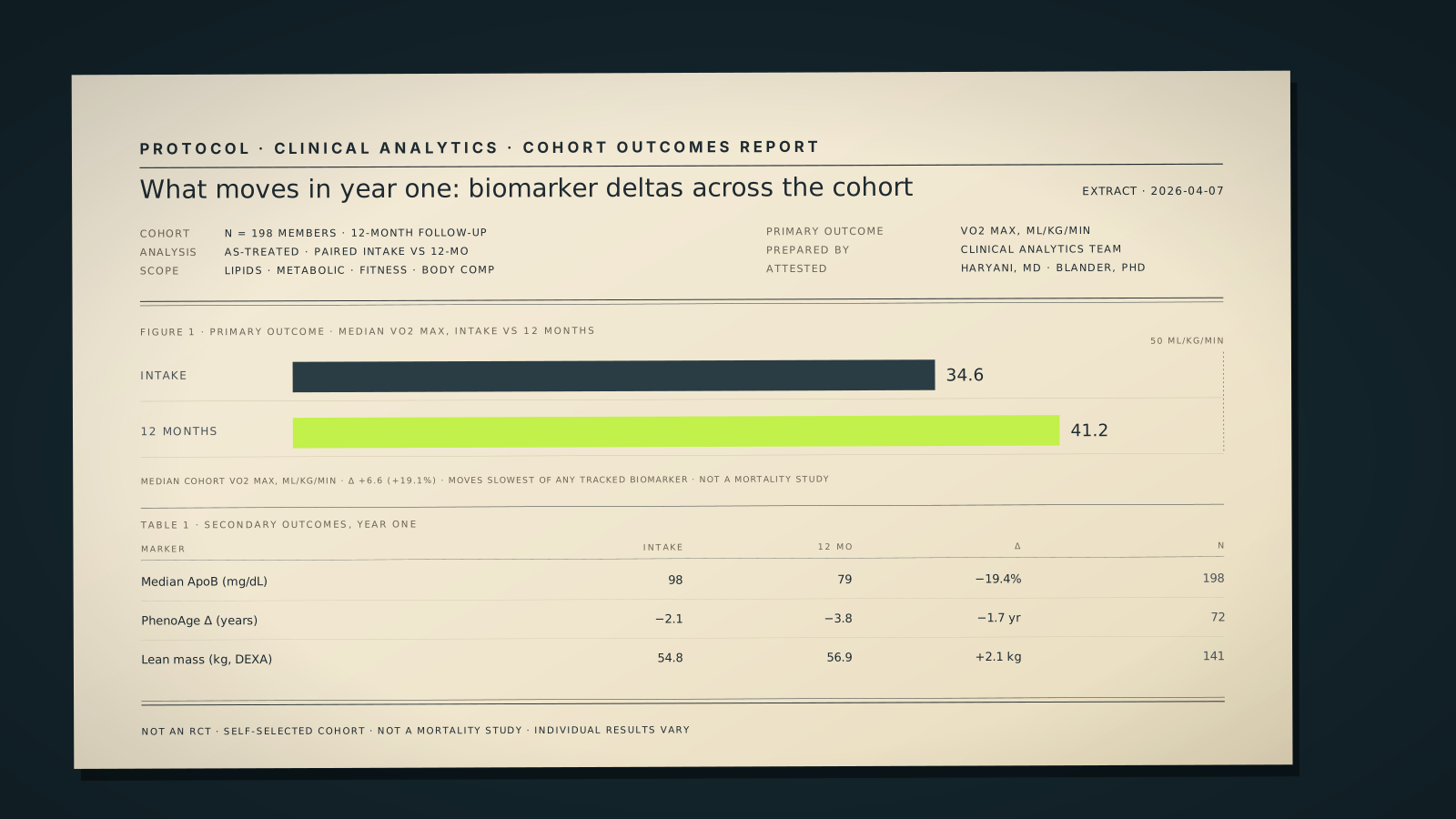
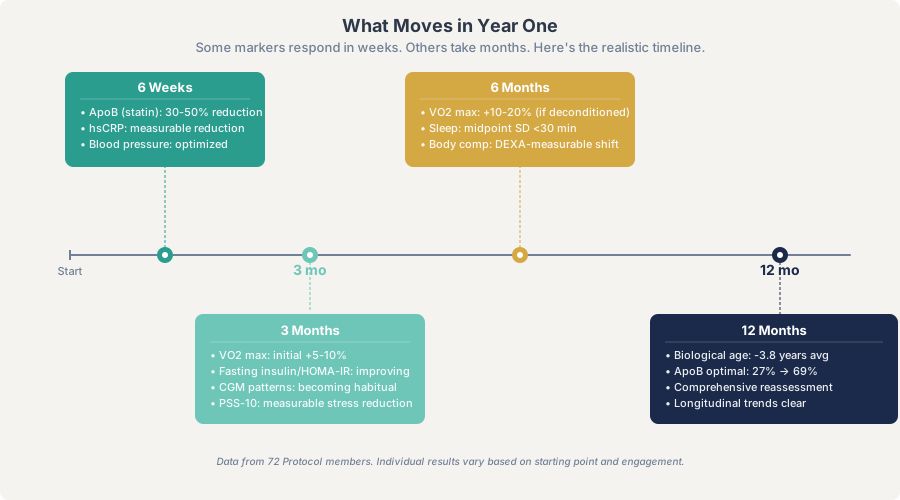
At intake, 27% of members had ApoB in the optimal range. That number rose to 69% during membership. Median ApoB across the cohort is now 79 mg/dL, and 88% are below 100 mg/dL.
This moves fast because for Tier A and Tier B members (those with ApoB above target), the intervention often includes medication: typically a statin, sometimes ezetimibe or a PCSK9 inhibitor. Medication is part of the protocol. Prescribing a statin when the evidence supports it isn’t a shortcut. It’s evidence-based medicine applied to the single strongest modifiable risk factor for heart disease.
Lifestyle changes (diet, exercise, weight management) do contribute to ApoB reduction. But for members starting above 130 mg/dL, the magnitude of change is almost always medication-driven. Statins do what they do. The lifestyle work still matters for everything statins don’t address: inflammation, insulin, sleep, fitness, body composition.
hsCRP reduction
High-sensitivity C-reactive protein, or hsCRP, is a marker of systemic inflammation. It responds to lifestyle changes (better sleep, stress reduction, dietary shifts, weight loss) and to medication. Statins reduce hsCRP through an anti-inflammatory mechanism that’s independent of their lipid-lowering effect.
Members starting with elevated hsCRP (above 3.0 mg/L, the high-risk threshold) typically see measurable reductions within 8-12 weeks of beginning their protocol. Structured lifestyle intervention plus targeted medication, when indicated, produces a faster response than either alone.
Blood pressure optimization
Protocol uses 24-hour ambulatory blood pressure monitoring (ABPM) rather than single office readings. ABPM captures blood pressure during sleep, work, exercise, and stress, which is the full picture a one-time cuff reading can’t give you.
Blood pressure responds to intervention within weeks: salt reduction, potassium optimization, stress management, better sleep, and medication when indicated. Members with masked hypertension (normal in the office, elevated the rest of the day) are frequently caught by ABPM and treated before end-organ damage accumulates.
What moves at medium speed: 3-6 months
VO2 max improvement
VO2 max is the maximum rate at which your body can use oxygen during exercise, and it’s one of the strongest independent predictors of all-cause mortality. It responds to structured training, but not overnight.
With Protocol’s exercise programming (Protocol 4), typically 2 sessions per week of zone 2 cardio (60-70% of max heart rate) plus 2-3 resistance training sessions, measurable VO2 max improvement begins around month 3 and continues through month 12 and beyond.
The rate of improvement depends heavily on starting fitness level. A deconditioned member starting at 25 mL/kg/min can see 15-20% improvement in 6 months. A moderately fit member starting at 38 mL/kg/min might see 5-10%. Both trajectories are clinically meaningful.
Sleep consistency improvement
Sleep midpoint standard deviation, the consistency of when you sleep, is Protocol’s lead sleep metric. Improving it takes time because you’re retraining a circadian pattern that may have been erratic for years.
Most members see measurable improvement (a reduction of 15+ minutes in sleep midpoint SD) within 8-12 weeks of consistently anchoring their wake time. Full stabilization, getting sleep midpoint SD below 30 minutes and keeping it there, typically takes 3-6 months.
The intervention is behavioral: fixed wake time seven days a week, narrowed weekend drift, morning light, limited screens at night. Nothing complicated. The hard part is that circadian patterns are stubborn and the temptation to sleep in on Saturday is real. Having a care team track the data and push back on the drift turns out to matter.
CGM-guided dietary patterns become habit
Protocol’s two-week CGM trial (Protocol 3) maps each member’s glucose response patterns: which foods spike them, which combinations moderate those spikes, how exercise timing and sleep quality interact with next-day glucose. The sensor comes off after two weeks.
What it leaves behind are specific behavioral changes: protein earlier in the meal, a walk after dinner, a few food swaps that blunt the worst spikes. Those take 3-6 months to stop being intentional. By month 6, most members aren’t consciously managing glucose anymore. They’ve just changed how they eat.
What takes longer: 6-12 months
Body composition changes
DEXA-visible changes in lean mass and visceral adipose tissue (VAT) take time. Muscle accretes slowly; fat redistribution is gradual. Expecting a meaningful DEXA delta at 3 months sets members up for disappointment.
At the 6-month scan, members in a structured resistance training program with adequate protein intake typically show a measurable increase in ASMI (Appendicular Skeletal Muscle Mass Index) and a reduction in VAT. By 12 months, these changes are clinically meaningful: often a 1-2 kg increase in lean mass and a reduction in visceral fat, even when total body weight changes minimally.
This is why Protocol doesn’t use weight as a progress metric. A member who gains 3 pounds of muscle and loses 4 pounds of visceral fat has dramatically improved their health profile. The scale shows a net loss of 1 pound, and that’s nearly meaningless as a health signal. (More on why body composition beats weight.)
Protein intake habits fully established
Hitting age-stratified protein targets (1.6-2.0 g/kg depending on age) requires restructuring meals in ways that take months to become second nature. Most members get to 80% of their target within the first month, once they see how far off their baseline intake actually is. Getting to consistent, daily target attainment across all meals, including the per-meal minimums of 30-40g, is a 6-12 month project.
The aggregate picture: biological age and cardiovascular risk
Biological age: -3.8 years average
Protocol calculates biological age using the Levine PhenoAge algorithm, a validated model based on 9 blood biomarkers (albumin, creatinine, glucose, CRP, lymphocyte percent, mean cell volume, red cell distribution width, alkaline phosphatase, and white blood cell count) that predicts mortality risk independent of chronological age.
Across our members, the average biological age gap is -3.8 years. The average member is biologically 3.8 years younger than their chronological age. 72% of members are biologically younger than their calendar age.
Two things worth saying plainly. PhenoAge is one of several biological age algorithms, validated and published, but not the only one. A different algorithm can produce a different number for the same person. And Protocol’s membership is self-selected. People who seek out a health optimization practice tend to be more health-conscious than average before they walk in the door. The -3.8 year gap reflects both what Protocol does and the baseline these members started from.
We use this number. We also think you should know how to read it.
Cardiovascular risk: 95% maintained or improved
Using age-adjusted cardiovascular risk scoring, which accounts for the fact that everyone’s risk goes up by 1 year of age between assessments, 95% of members maintained or improved their cardiovascular risk profile. Their risk either stayed flat (despite aging) or decreased.
This includes all interventions (medication, lifestyle, and behavioral changes), because the goal is cardiovascular risk reduction, not a test of any single lever. When a member starts a statin and their ApoB drops from 140 to 75, that improvement is real. The medication is doing what it should. And the member is measurably safer because of it.
What we cannot claim: the A1c question
A1c (glycated hemoglobin, a 90-day average of blood glucose) is flat across Protocol’s membership data. We cannot claim that membership improves A1c.
The longitudinal evidence is insufficient. Most members enter with normal A1c (below 5.7%), which means there’s limited room for improvement. For the small number of members with elevated A1c at intake, the data set is too small and the follow-up period too short to draw conclusions.
This matters because it would be easy to leave out. Every other number in this article is positive. A1c is neutral. Omitting it would make the results page look cleaner. But if you’re making a decision about whether to join Protocol, you deserve to know what we can demonstrate and what we can’t. A1c improvement is something we can’t demonstrate yet.
What these results actually mean
ApoB improves fast, and much of that is medication. A statin prescription isn’t a bypass of the protocol. It is the protocol working. The evidence for statin therapy in primary prevention for people with elevated ApoB is strong, and withholding it in the name of “lifestyle only” isn’t rigorous. It’s just less effective medicine.
Sleep consistency, VO2 max, and body composition improve more slowly and are almost entirely behavior-driven. These require sustained effort over months, not a prescription pad. hsCRP and blood pressure sit somewhere in between. They respond to both levers, and the combination moves faster than either alone.
And then there are the biomarkers that don’t move: A1c for most of our members, certain inflammatory markers tied to conditions outside Protocol’s scope, genetic factors that don’t bend to intervention at all. We report those too.
Across 12 months and our full membership, structured intervention (clinical assessment, targeted medication when indicated, coached behavior change, continuous monitoring) produces measurable improvement in the biomarkers that predict disease, disability, and early death. Not for every member, not in every metric. But consistently enough, in the numbers that matter, that we’re comfortable putting them in writing.
The timeline summarized
| Timeframe | What moves | Primary driver |
|---|---|---|
| Weeks 6-12 | ApoB, hsCRP, blood pressure | Medication + early lifestyle changes |
| Months 3-6 | VO2 max, sleep consistency, CGM-guided habits | Structured training + behavioral coaching |
| Months 6-12 | Body composition (DEXA), protein habits, biological age | Sustained resistance training + nutrition |
Ready to see what 12 months of structured health optimization can do for your numbers? Book a Discovery Call to learn what Protocol membership includes and how the first 90 days work.