

 ← Back to Blog
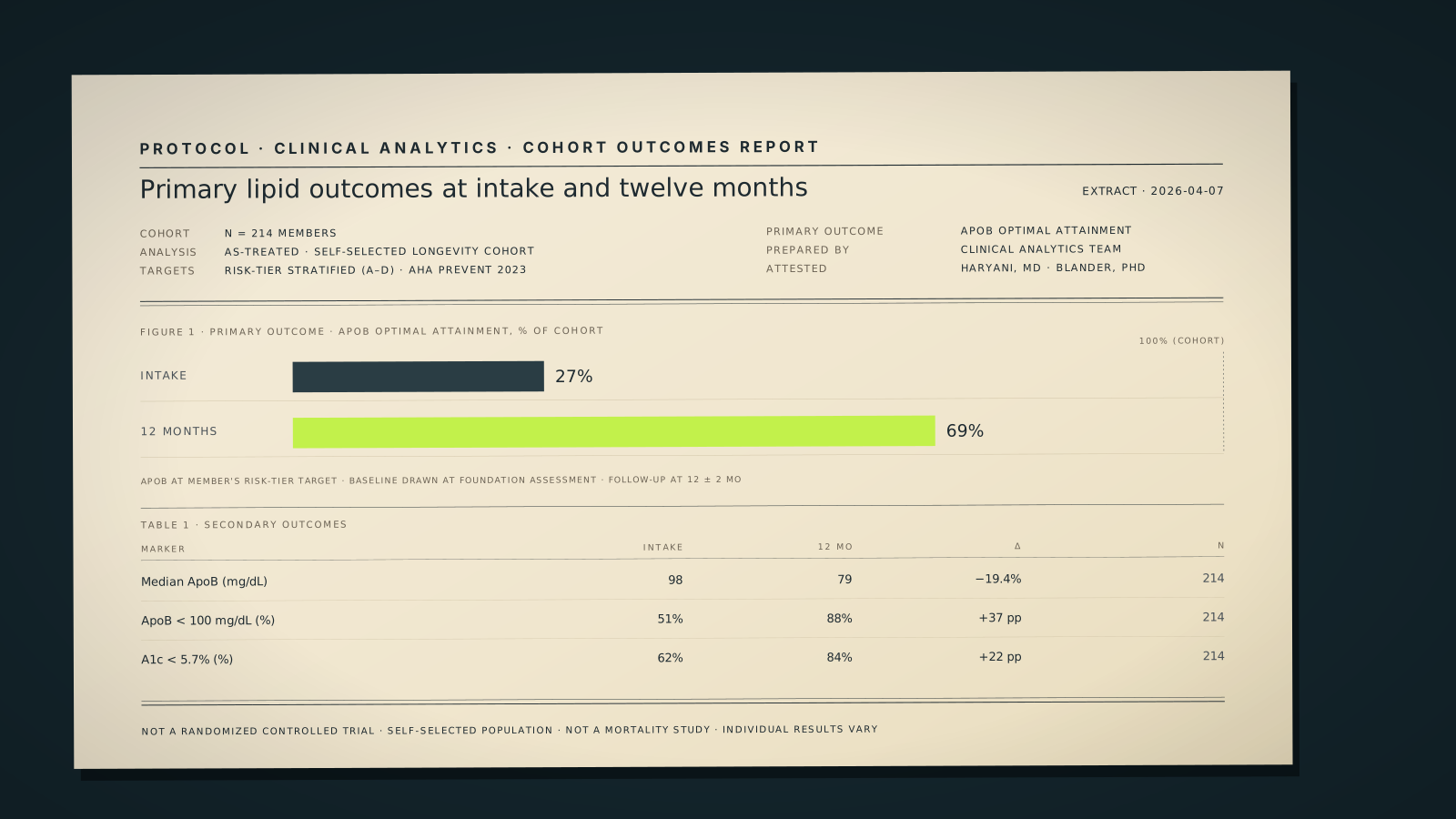
 How our members cut ApoB optimal attainment from 27% to 69%

How our members cut ApoB optimal attainment from 27% to 69%
We’re going to show you the data. All of it, including the parts that are less flattering.
Protocol tracks aggregate health outcomes across all members in our clinical analytics pipeline. Not thousands. Not a randomized controlled trial. A real cohort of members who joined a health optimization practice and followed protocolized interventions.
Here’s what the ApoB data shows, and where the caveats are.
The headline numbers
At intake, 27% of Protocol members had ApoB at their risk-tier-appropriate target.
During membership, 69% do.
That’s a 2.6x improvement in optimal attainment. Median ApoB across all members is 79 mg/dL, against a US population mean of approximately 95 mg/dL (NHANES). 88% of Protocol members have ApoB below 100.
These are real numbers from real people, calculated from the same clinical analytics pipeline we use to manage care. Every member is counted. Nothing excluded.
What ApoB is and why it matters
If you’re unfamiliar with ApoB, here’s the short version. (The longer version is here.)
Apolipoprotein B (ApoB) is a protein found on the surface of every lipoprotein particle that can deposit cholesterol into your arterial walls. LDL, VLDL, and Lp(a) particles each carry exactly one.
ApoB counts those particles. LDL-C, the number on your standard cholesterol panel, measures the cholesterol mass inside LDL particles, a different thing entirely. The two disagree in roughly 20-30% of people, and when they do, ApoB is the better predictor of cardiovascular events. The Emerging Risk Factors Collaboration confirmed this across 300,000+ participants in analyses published in JAMA and The Lancet.
Roughly half of people hospitalized for a coronary event had LDL-C below 100 mg/dL at admission (Sachdeva et al., Am Heart J, 2009). Conventional lipid panels suggested their cholesterol was fine. Particle count told a different story.
Protocol uses ApoB, not LDL-C, as the primary target in our Cardiovascular Risk protocol.
How the improvement happened
Here’s the honest version.
We tested what most practices don’t. Most annual physicals include a standard lipid panel: total cholesterol, LDL-C, HDL-C, triglycerides. ApoB is not on that panel. Neither is Lp(a), fasting insulin, hsCRP, or ApoE genotype. Every Protocol member gets these tested as part of their Foundation Assessment. For many, this was the first time anyone had checked their ApoB.
We risk-stratified every member. ApoB targets are not one-size-fits-all. A member with established cardiovascular disease, elevated Lp(a), and a family history of early heart attacks may need an ApoB below 65 mg/dL, and in some cases below 55 mg/dL under emerging aggressive prevention protocols. A member with no risk factors and clean imaging may have a target below 100.
Protocol uses a 4-tier risk stratification system (Tier A through D) informed by the AHA PREVENT equations (2023), Lp(a) levels, family history, coronary artery calcium scores, and inflammatory markers. Each member gets a target based on their actual risk profile. When we say 69% are “at target,” we mean 69% are at their target, not some blanket number that applies to everyone.
We built a protocol and followed it. Each member in the Cardiovascular Risk protocol gets a specific plan:
- Dietary changes matched to their ApoE genotype (how your body processes lipids varies by genotype)
- Exercise prescription coordinated across protocols
- Supplement protocol if indicated (omega-3, when supported by the evidence)
- Pharmacotherapy when the gap between current ApoB and target is too large for lifestyle alone
Three sessions over 6 weeks. A recheck at 12 weeks if pharmacotherapy was started. Ongoing monitoring every 6-12 months after that.
We checked whether it worked. Most practices skip this step. You start a statin. Nobody rechecks ApoB. Nobody verifies that the medication worked, or adjusts if it didn’t.
Protocol rechecks every member. If the first intervention doesn’t close the gap, we escalate: dose adjustment, combination therapy (adding ezetimibe), or referral to a lipidologist for complex cases. The protocol doesn’t stop until the member is at target or we’ve exhausted the evidence-based options.
What we don’t claim
Read this section before you decide anything.
The improvement is largely medication-driven. The majority of the ApoB improvement in our members involves pharmacotherapy. Statins. Ezetimibe. Well-established medications with decades of clinical trial data.
Protocol did not invent a new drug. What we built is a system: the right test gets ordered, a personalized target gets set, medication gets prescribed when the gap is too large for lifestyle alone, and someone actually checks whether it worked. The medications, statins, ezetimibe, PCSK9 inhibitors where indicated, are standard. The system that makes sure they get used correctly is the difference.
There is no control group. These are observational outcomes from our membership. We don’t have a matched group of similar people who didn’t join Protocol, so we can’t isolate what would have happened without our intervention. Some members may have eventually gotten their ApoB tested and treated elsewhere. Some may not have. We don’t know, and we don’t pretend to.
The population is also self-selected. People who join a health optimization practice at $695/month are not a random sample of the US population. They’re health-motivated, higher-income, and more likely to follow through on interventions. Some of Protocol’s numbers reflect who joins, not just what Protocol does. We acknowledge this because it’s true, and because pretending otherwise would undermine everything we’re trying to build.
The A1c data is flat. We’re including this because cherry-picking the best numbers is exactly what we’re arguing against. Among 34 members with A1c readings at least 60 days apart, the average barely moved: 29% improved, 38% stayed stable, 32% worsened slightly. Metabolic change is harder to move than lipid targets, and we haven’t cracked it at scale.
We publish this because transparency matters more than marketing. If we only showed you ApoB and hid the A1c data, you should trust us less.
We do not claim to extend lifespan. There is no mortality data. Our cohort over a few years cannot demonstrate lifespan extension. What we can show is that specific, measurable biomarkers moved in the direction that decades of epidemiological research associates with lower cardiovascular risk. That’s a meaningful claim. It’s not the same as “you’ll live longer.”
What the data does show
Here’s what we stand behind.
The pipeline works. Test the right biomarker, set a target based on actual risk, intervene, verify the result. 27% to 69% is a real improvement in a real cohort.
At intake, 73% of members had suboptimal ApoB. These are health-conscious people, many of whom had annual physicals and were told their labs were “normal.” The right test told a different story.
Prescribing a statin is not the same as getting someone to target. That’s where the gap between standard care and Protocol shows up most clearly, in whether anyone actually checks.
The broader picture holds up too. 95% of members’ cardiovascular risk (measured by the AHA PREVENT equations, age-adjusted) is stable or improved. Biological age averages 3.8 years younger than chronological age across 68 members, estimated using Levine PhenoAge, a validated algorithm published in Aging (2018). 72% of members are biologically younger than their calendar age.
Why we publish all of this
Most health practices don’t publish their aggregate outcomes. Small sample sizes, variable methodology, legal caution. We understand the hesitation.
We publish anyway. If you’re comparing health practices, you should be able to see the numbers and evaluate them yourself.
This is not a clinical trial. But it’s a real cohort with real data, and every number on this page is defensible. We’d rather show you imperfect data honestly than perfect marketing that hides the caveats.
The full breakdown and individual member outcomes are on our Case Studies page.
Book a discovery call
These are aggregate outcomes. Your numbers will be different, better in some areas, worse in others. The Foundation Assessment shows you where you stand. A discovery call is 15 minutes, no commitment. We’ll tell you what to expect for your situation.
Related Content
Cardiovascular Risk→