

 ← Back to Blog
 Biological age: what we learned from testing 72 members

Biological age: what we learned from testing our members
Your driver’s license says one number. Your blood says something different.
Biological age testing measures how fast your body is actually aging, not based on when you were born, but based on how your organs, cells, and metabolic systems are functioning right now. Two 50-year-olds can have wildly different biological ages depending on their cardiovascular health, metabolic function, inflammation, and organ performance.
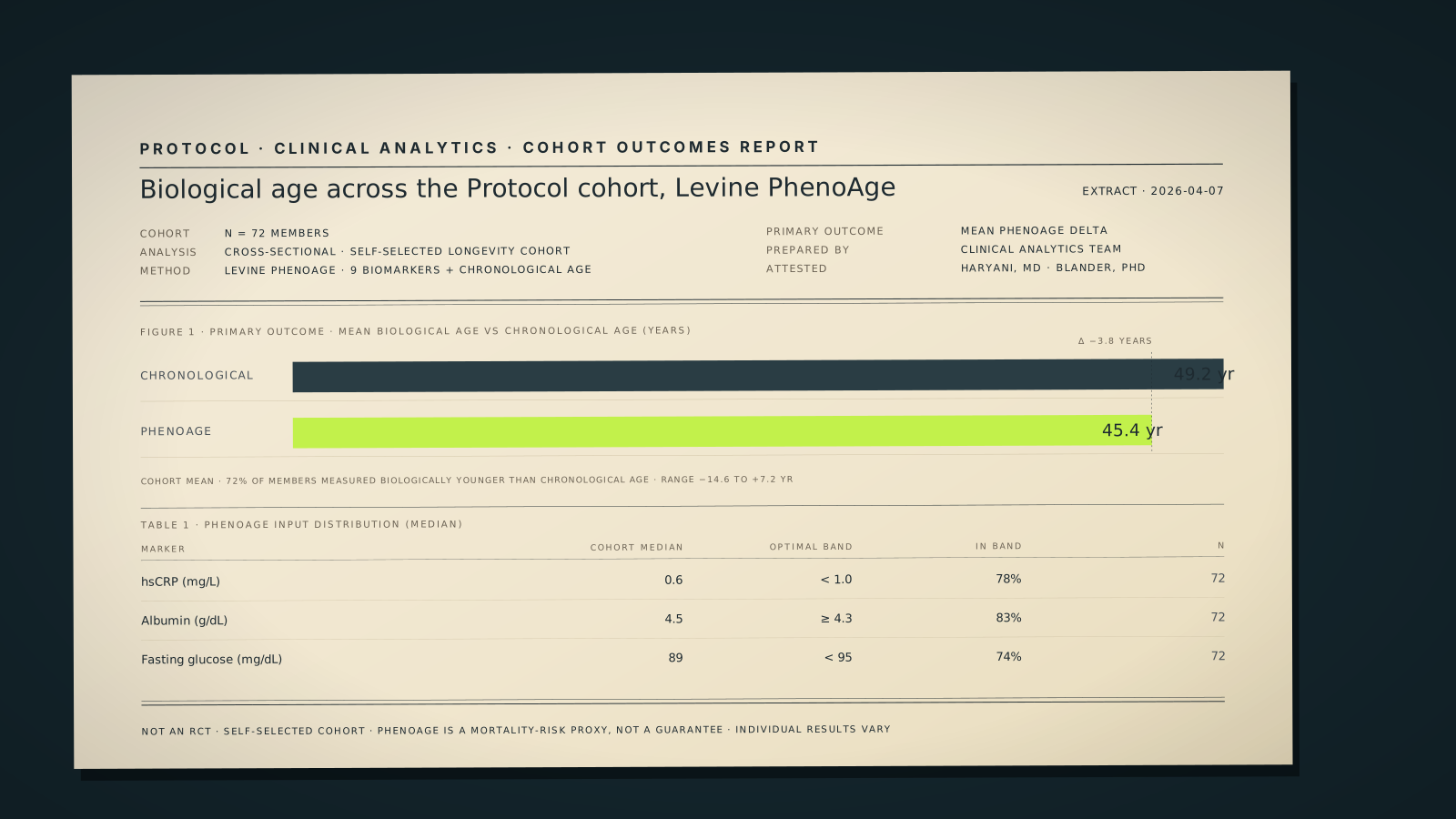
We calculated biological age for every member of Protocol’s practice. Across the full cohort, average biological age was 3.8 years younger than chronological age. 72% of members were biologically younger than their calendar age.
Here’s how we measured it, what the numbers mean, and (just as important) what they don’t.
What we measured and how
Protocol uses the Levine PhenoAge algorithm, published in Aging in 2018 and validated on two large national health surveys (NHANES III and NHANES IV) with mortality follow-up data. Despite the paper’s title referencing “epigenetic biomarker,” PhenoAge is not a DNA methylation test or an epigenetic clock. It’s a blood biomarker composite: a mathematical model built from nine routine lab values plus your chronological age.
The nine inputs:
- Albumin: liver function and nutritional status
- Creatinine: kidney function
- Glucose: metabolic health
- C-reactive protein (CRP): systemic inflammation
- Lymphocyte percentage: immune function
- Mean cell volume (MCV): red blood cell size, reflects nutritional and bone marrow health
- Red cell distribution width (RDW): variation in red blood cell size, an independent mortality predictor
- Alkaline phosphatase: liver and bone health
- White blood cell count: immune activity and inflammation
The algorithm combines these nine values with your chronological age to produce a single number: your estimated biological age. The model was originally trained to predict mortality. It identifies the combination of biomarker values that statistically predict lifespan, independent of calendar age.
A biological age lower than your chronological age means your biomarker profile looks like someone younger. Higher means the opposite.
Why these nine markers
PhenoAge works because it captures multiple systems at once. Glucose reflects metabolic health. CRP reflects inflammation. Albumin and alkaline phosphatase reflect liver function. Creatinine reflects kidney function. Lymphocyte percentage and white blood cell count reflect immune status. MCV and RDW reflect hematological health.
No single marker tells you much about how fast you’re aging. The pattern across all nine, how your metabolic, inflammatory, hepatic, renal, immune, and hematological systems are performing together, produces a composite picture that predicts mortality better than chronological age alone.
Aging is not one process. It’s dysfunction accumulating across multiple organ systems simultaneously. A test that captures dysfunction across nine systems will be more informative than one that measures only one.
What we found across our members
Most members had all nine biomarkers available for the full PhenoAge calculation. A smaller subset used the Klemera-Doubal (KDM) method, a validated biological age algorithm that works with a different marker set, applied when one or more PhenoAge inputs were missing. Both methods produce age-in-years estimates calibrated to the same population reference data, making them comparable in direction and magnitude, though not interchangeable.
Across our full cohort:
- Average biological age gap: -3.8 years (biologically younger than chronological age)
- 72% of members had a biological age lower than their chronological age
- The remaining 28% were biologically older. Their biomarker profiles resembled someone older than their calendar age
The range was wide. Some members were biologically 8-10 years younger. A smaller number were 2-4 years older. The -3.8 average masks real individual variation, which is the point: biological age is specific to you, not a population average.
What this means, and what it doesn’t
The caveats matter, and we include them because claiming more than the data supports erodes the trust that takes years to build.
The honest version: the average Protocol member has a biomarker profile consistent with someone 3.8 years younger than their chronological age, as estimated by a validated, peer-reviewed algorithm.
What we can’t claim:
We can’t say Protocol caused this. The data is cross-sectional, a snapshot of where members are now, not a before-and-after comparison. We don’t have pre-membership biological age calculations for most members. Some portion of that -3.8 year gap likely existed before they joined.
We can’t say members will live longer. PhenoAge was validated against mortality data in large population studies. We have no mortality data on our own members (thankfully). A younger biological age is associated with lower mortality risk in research populations; we can’t extend that claim to our members specifically.
This is a self-selected population. People who seek out a health optimization practice and pay for ongoing membership are, on average, more health-conscious, wealthier, and more educated than the general population. All of these factors independently predict better health outcomes. The -3.8 year average reflects both what Protocol does and who Protocol attracts.
We report this number because it’s real and useful. We caveat it because the data deserves to be read accurately.
Why biological age matters for you
Even with those caveats, biological age testing answers a question no single lab value can answer on its own: across your major organ systems, how is your body performing relative to your age?
The individual lab values that feed into PhenoAge are the same ones that predict disease. Elevated CRP predicts cardiovascular events. High fasting glucose predicts diabetes. Rising creatinine signals declining kidney function and predicts progression to chronic kidney disease. Abnormal liver enzymes predict hepatic disease. Elevated RDW independently predicts all-cause mortality after adjusting for other biomarkers, even in people whose individual values fall within standard reference ranges.
Most annual physicals report these values individually, with binary “normal” or “abnormal” flags. A CRP of 1.8 mg/L is “normal.” A fasting glucose of 99 mg/dL is “normal.” An albumin of 3.8 g/dL is “normal.” But all three together, in a 45-year-old, paint a picture that none of them paints alone.
Biological age testing takes nine data points your annual physical already collects (or should collect) and combines them into a single metric: your body is aging faster than expected, slower, or right on track.
How we use biological age at Protocol
Biological age is part of every member’s annual reassessment. It does a few distinct things depending on where someone is in their membership.
At intake, it gives us an immediate signal about which systems are contributing to faster or slower aging. A member whose biological age is 5 years older than their chronological age likely has specific biomarkers driving that gap. Maybe elevated CRP from chronic inflammation, maybe rising glucose from early insulin resistance. The calculation tells us which protocols to prioritize.
For ongoing members, it tracks whether the work is actually moving the composite picture, not just individual numbers in isolation. If a member brings their CRP from 3.2 down to 0.8 through sleep and dietary changes, that shows up in the next calculation.
And practically: “Your ApoB dropped from 130 to 78” is clinically meaningful but abstract for most people. “You’re biologically 4 years younger than your age” is clinically meaningful and immediately understandable. Both matter. The second one tends to stick.
What actually moves biological age
Biological age is a mathematical output of nine measurable inputs. Move the inputs, move the number.
- CRP (inflammation): sleep consistency, dietary changes, weight loss, stress management, plus statin therapy when indicated, which has anti-inflammatory effects independent of lipid lowering
- Glucose (metabolic health): meal sequencing, post-meal movement, resistance training, CGM-guided dietary changes. This is the core of Protocol’s Metabolic Health protocol
- Creatinine (kidney function): hydration, blood pressure management, avoiding nephrotoxins
- Albumin and alkaline phosphatase (liver function): reduce alcohol, address fatty liver, ensure adequate protein intake
- Lymphocyte percentage and WBC (immune function): sleep, exercise, stress management, adequate nutrition
None of these are exotic. They’re the same interventions that improve individual biomarkers. They just also happen to move the composite score.
The members in our practice who are 5-10 years biologically younger are not doing anything radical. They’re consistently managing cardiovascular risk (ApoB below target), metabolic health (HOMA-IR in optimal range), inflammation (CRP below 1.0), and body composition. The work isn’t exotic. It just gets done.
How to get your biological age tested
To calculate PhenoAge, you need all nine biomarkers from a single blood draw. Most standard panels include some of them (glucose, creatinine, albumin, WBC). A few are less commonly ordered on routine panels (CRP, lymphocyte percentage, RDW, alkaline phosphatase, MCV). The full set costs $50-100 through a direct-to-consumer lab.
Several online calculators will compute PhenoAge from these inputs. The original algorithm is published and freely available.
The calculation itself is easy. The harder part is knowing which biomarkers are driving your result, which ones are actually modifiable for you specifically, and what interventions will move them. A number without that context is just a number.
The numbers behind our numbers
We publish our data because a practice that only shows its wins isn’t showing you much. The full picture from Protocol’s cohort:
- ApoB optimal attainment: 27% at intake, 69% during membership. See the full ApoB story
- Biological age: -3.8 years average, 72% biologically younger
- Cardiovascular risk: 95% maintained or improved on age-adjusted scoring
- A1c: flat. We cannot claim improvement (why honesty about this matters)
The numbers that moved and the ones that didn’t. You deserve to make decisions based on the complete picture.
Ready to find out where you stand? Protocol’s Foundation Assessment measures what your annual physical misses (ApoB, HOMA-IR, DEXA body composition, VO2 max) and builds a specific action plan from the data.
Related Content
Member Results→