

 ← Back to Blog
 Your HRV Is Telling You Something. Here's How to Read It
Your HRV is telling you something. Here’s how to read it.
You have a number on your wrist (or your finger, or the strap on your chest) that most people check every morning and almost nobody knows how to interpret. Your HRV. Heart rate variability. It went up 8 points last night. Or down 12. You feel the same as yesterday. What does the number mean, and what should you do with it?
What HRV actually measures
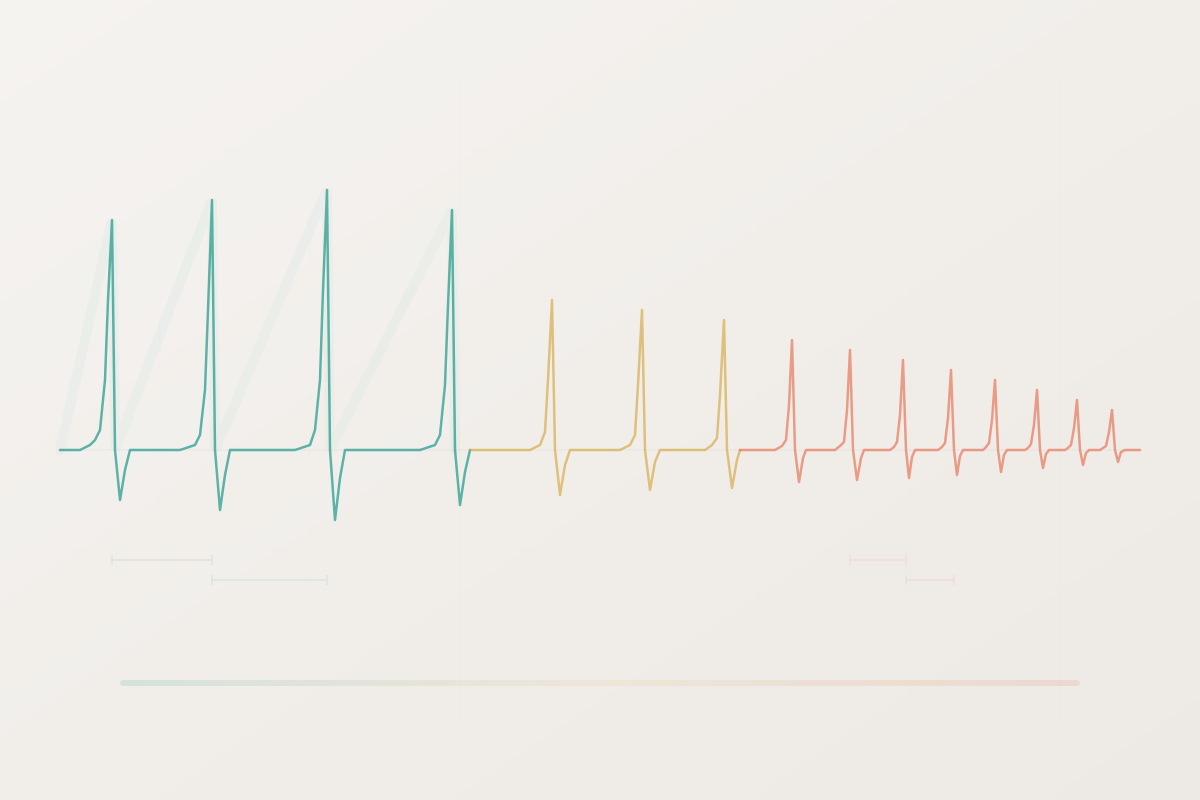
Your heart does not beat like a metronome. Even at a steady 60 beats per minute, the interval between each beat varies. Maybe 980 milliseconds between one pair of beats, 1,020 between the next, 960 after that. HRV quantifies this variation.
The metric that matters most for daily tracking is RMSSD (the root mean square of successive differences in heartbeat intervals), which captures your parasympathetic nervous system’s influence on your heart. Higher RMSSD means more variation between beats, indicating strong parasympathetic (vagal) tone: the branch of your nervous system associated with rest and recovery. Lower RMSSD means less variation and reduced vagal influence, often associated with higher allostatic load.
One thing people get wrong: higher HRV is not always “better” in absolute terms. A 25-year-old athlete and a 55-year-old executive will have different baselines. What matters is your trend relative to your own baseline, not someone else’s number.
What your wearable CAN tell you
Oura rings, Apple Watches, Whoop straps, and Garmin devices all measure some version of HRV. Where they actually hold up:
Sleep timing and consistency. Your wearable knows when you fell asleep and when you woke up, and it is accurate enough to track whether your sleep schedule is consistent night to night. Irregular sleep timing is one of the strongest predictors of poor sleep quality, and your wearable captures this automatically without you having to think about it.
Resting heart rate trend. Most wearables track nightly resting heart rate reliably. An upward trend over days or weeks (your average creeping from 52 to 58, say) is worth paying attention to. Illness, overtraining, alcohol, poor sleep, and chronic stress all push resting heart rate up.
HRV trend direction over weeks. Not last night’s number versus the night before. The 7-day or 14-day rolling average is what matters. Is it drifting up, holding steady, or declining? Trends over weeks carry signal. Single-night readings mostly don’t.
Activity and strain tracking. Total daily movement, workout intensity, step counts. Wearables are reasonably good at capturing load over time, which gives context to your HRV numbers.
What your wearable CANNOT tell you
This is where most people over-rely on their devices:
Accurate sleep staging. Your ring or watch cannot reliably tell you how much deep sleep or REM sleep you got. Wrist-based and finger-based devices estimate sleep stages using movement and heart rate, not the electrical brain signals (EEG) that clinical polysomnography uses. The estimates correlate with reality at a population level but fall apart on individual nights.
The script we use in our Sleep Health protocol: “Your ring is excellent at tracking WHEN you sleep and how CONSISTENT you are. It is not accurate enough to tell you HOW you slept in terms of sleep stages.”
Diagnosing sleep disorders. A wearable cannot diagnose sleep apnea, restless leg syndrome, or other sleep conditions. If you suspect a sleep disorder, you need a clinical sleep study, not an app readout.
Single-night HRV decisions. Your HRV dropped 15 points last night. Should you skip your workout? Maybe. Or maybe you had an extra glass of wine, slept in a warmer room, went to bed later than usual, or are fighting off a cold you don’t feel yet. A single-night HRV reading has too many confounders to drive specific decisions. The 7-day average is where the signal lives.
Protocol’s HRV measurement protocol
In our Emotional Resilience protocol, we don’t rely on overnight wearable readings for HRV. We use a standardized morning measurement:
- Same time daily: within 30 minutes of waking
- Supine: lying on your back
- Before coffee: caffeine alters heart rate variability
- Chest strap sensor: not wrist-based or finger-based
- 2-minute settling period: lie still, let your heart rate stabilize
- 5-minute recording window: this is the actual measurement
Why a chest strap instead of your Oura or Apple Watch? Chest straps measure the electrical signal of each heartbeat (similar to an ECG). Wrist-based devices use optical sensors that estimate heart rate from blood flow changes in your skin. For beat-to-beat precision (which is what RMSSD requires), the chest strap is meaningfully more accurate. The difference doesn’t matter much for resting heart rate, but it matters for the millisecond-level precision that HRV demands.
We track the 7-day rolling average of RMSSD. An upward trend over weeks means vagal tone is recovering. A downward trend warrants investigation.
Where HRV connects to everything else
HRV is not a standalone metric. It reflects three systems we track across different protocols.
Sleep quality (Protocol 5: Sleep Health)
Poor sleep drops next-morning HRV. This is consistent and measurable. A member who shifts from 7.5 hours of consistent sleep to 6 hours of fragmented sleep will see their HRV 7-day average decline within the first week.
We use this clinically as a feedback loop: declining HRV prompts us to investigate sleep first, because sleep is the most common and most fixable cause. Our Sleep Health protocol addresses the specific interventions (consistent sleep timing, temperature optimization, light exposure management), and we track whether those interventions are working through the HRV trend.
Exercise recovery (Protocol 4: Movement)
Overtraining suppresses HRV. When training load exceeds recovery capacity for long enough, the 7-day HRV average drops and stays down. The body needs more recovery, not more volume.
For members who train hard, HRV is one of the objective signals we use (alongside resting heart rate and subjective readiness) to modulate training intensity. A single low HRV morning does not mean skip the workout. Two weeks of declining trend means something needs to change.
Stress load (Protocol 8: Emotional Resilience)
Chronic psychological stress compresses HRV range. The mechanism: sustained sympathetic nervous system activation (fight-or-flight mode) suppresses the parasympathetic variability that RMSSD captures. A member under sustained work stress, relationship stress, or life transition stress will often see their HRV range narrow. The average drops and day-to-day readings cluster in a tighter, lower band.
This is where HRV data intersects with PSS-10 scores and CGM glucose variability data (detailed here). When all three signals move the same direction (perceived stress rising, HRV declining, non-food glucose spikes increasing), we have high confidence that the stress load is physiologically real, not just a mood report.
How to read your HRV: the practical guide
Look at trends, not daily numbers
A single reading is noise. The 7-day rolling average is signal. If your 7-day average has been climbing for three weeks while your sleep and training have been consistent, something is working. If it has been declining for three weeks, something is wrong.
Know your confounders
These things drop HRV and are not cause for concern:
- Alcohol: even one drink suppresses overnight HRV. Normal. It recovers within 24-48 hours.
- Late meals: eating close to bedtime keeps your body in a higher metabolic state during early sleep.
- Hot sleeping environment: thermoregulation demands compete with parasympathetic recovery.
- Travel and time zone changes: circadian disruption compresses HRV temporarily.
Know your warning signs
These patterns warrant investigation:
- Sustained decline over 2+ weeks without an obvious cause (illness, travel, alcohol). Could indicate overtraining, accumulating sleep debt, or chronic stress.
- Loss of variability: your daily readings used to bounce between 45 and 70, and now they hover between 48 and 55. The range compression matters as much as the average.
- HRV decline paired with rising resting heart rate: when both metrics move the wrong direction at the same time, something systemic is happening. Illness and overtraining are the most common causes.
What NOT to do
- Do not cancel a workout because last night’s HRV was low. One reading is not actionable.
- Do not compare your number to someone else’s. Age, sex, fitness level, and genetics all influence baseline HRV.
- Do not chase a specific number. There is no “good” HRV. There is your baseline and the direction it is moving.
- Do not change three things at once and try to attribute a change to one of them. Modify one variable at a time and watch the trend.
The gap between data and action
The problem with wearable HRV data is not accuracy. It is interpretation. You get a number every morning. The number moves. And then nothing happens, because you don’t know what it means in the context of your sleep, training, stress, nutrition, and health history.
Protocol fills that gap. Our care team interprets your HRV trend alongside PSS-10 scores, sleep consistency data, training load, and metabolic markers. When your HRV moves in a direction we don’t like, we know which variable to investigate first, because we are tracking all of them.
The number alone doesn’t tell you much. What the number means inside your particular biology, schedule, and stress load: that’s the actual work.
Getting a number every morning and not sure what to do with it? Protocol’s Emotional Resilience and Sleep Health protocols interpret your HRV data alongside stress assessments, sleep metrics, and training load, so the number actually leads to action.
Book a Discovery Call to learn how we turn wearable data into a coached protocol.