

 ← Back to Blog
 Stress has a number: how we measure what most doctors ignore
Stress has a number: how we measure what most doctors ignore
Your doctor measures your cholesterol, your blood pressure, your fasting glucose. Numbers with targets. When they drift, there’s a protocol to bring them back.
Your stress? You get a shrug and “try to relax more.” Maybe a pamphlet. No measurement, no baseline, no target, no follow-up, just a general acknowledgment that stress is bad, which you already knew.
Stress is a biomarker, as measurable as ApoB, as trainable as VO2 max. At Protocol, our Emotional Resilience protocol treats it that way: with specific numbers, validated tools, and coached interventions backed by evidence. Here are three ways we measure what most doctors don’t.
Tool 1: the PSS-10, your stress biomarker in 3 minutes
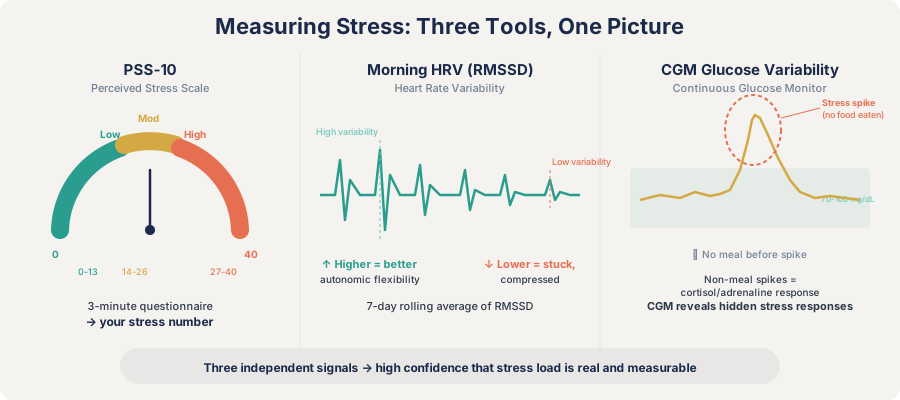
The Perceived Stress Scale (PSS-10) is a 10-item validated questionnaire that produces a score from 0 to 40. It takes about three minutes. It costs nothing. And it gives you something most people have never had: an actual number for your stress.
The scoring: 0–13 is low perceived stress, 14–26 is moderate, 27–40 is high.
That number becomes your baseline. We track it over time the same way we track your lipid panel. A score of 24 in January that drops to 16 by April tells us something specific: the interventions are working, and we can quantify how much.
The PSS-10 won’t tell you why you’re stressed. But it gives you and your care team a shared reference point, a number you can both see, discuss, and move.
Most physicians have never administered the PSS-10 to a patient. Not because it’s obscure (it’s one of the most widely cited stress instruments in the research literature) but because the standard clinical workflow doesn’t create space for measuring things it has no protocol to treat. We built the protocol around exactly this gap.
Tool 2: morning HRV, your autonomic nervous system, quantified
HRV (heart rate variability) measures the variation in time between consecutive heartbeats. Higher variability generally indicates a nervous system that can flexibly shift between activation and recovery. Lower variability suggests a system that is stuck, compressed, unable to adapt.
The metric we use is RMSSD, the root mean square of successive differences in heartbeat intervals, which captures the parasympathetic nervous system’s influence on the heart. It’s the gold standard for short-term HRV assessment.
The measurement protocol:
- Same time daily, within 30 minutes of waking
- Supine, lying on your back
- Before coffee, since caffeine changes the reading
- Chest strap rather than a wrist-based wearable (more on why in our HRV guide)
- Two-minute settling period to let the body stabilize
- Five-minute recording window
One reading tells you almost nothing. What matters is the 7-day rolling average of RMSSD. An upward trend over weeks means improving autonomic flexibility. A sustained downward trend warrants investigation: overtraining, poor sleep, illness, or chronic stress load.
This connects directly to other protocols. Poor sleep (addressed in our Sleep Health protocol) suppresses next-morning HRV. Overtraining compresses HRV range. Chronic psychological stress does the same. HRV is where these systems converge, which is why we track it.
Tool 3: CGM glucose variability as a stress proxy
If you’re wearing a continuous glucose monitor, something we use in our Metabolic Optimization protocol, you already have a third stress measurement tool that most people overlook.
Glucose spikes that don’t correspond to meals are often stress responses, though other factors like dawn phenomenon, intense exercise, or illness can produce them too. When those explanations are ruled out, cortisol and epinephrine are the likely culprits: both trigger hepatic glucose output, dumping glucose into your bloodstream as part of the stress response. A 30 mg/dL spike at 2 PM when you last ate at noon, were sedentary, and had nothing but water since? Probably not food. Probably your nervous system reacting to something.
We use this as cross-protocol data. When a member’s non-food glucose variability increases, it often correlates with rising PSS-10 scores and declining HRV trends. Three independent signals pointing the same direction gives us high confidence that the stress load is real and measurable, not subjective, not vague.
What we do with the numbers
Measuring stress is only useful if you have interventions that move the measurements. Here are the three that Protocol 8 prescribes, each with specific evidence behind it.
Cyclic sighing: 5 minutes daily
Balban et al. published a randomized controlled trial in Cell Reports Medicine in 2023 comparing three breathwork techniques against mindfulness meditation. Cyclic sighing, 5 minutes per day for 28 days, outperformed mindfulness meditation for positive affect improvement and anxiety reduction.
The technique: two nasal inhales (the second tops off the lungs after the first), followed by an extended oral exhale. Repeat for 5 minutes.
We cover this in depth in our cyclic sighing deep-dive. In Protocol 8, this is a daily practice. We prescribe it the same way a clinician would prescribe a medication: specific dose, specific timing, specific duration.
For acute stress, a difficult conversation, a moment of overwhelm, we use the physiological sigh. Same mechanic, but a single cycle instead of 5 minutes. Two nasal inhales, one extended exhale. About 10 seconds. It works in the moment because it’s designed to.
Three good things: evidence-based cognitive reframing
Each night, write down three things that went well that day and your role in making them happen. This comes from Seligman’s positive psychology research (2005) and Emmons and McCullough’s gratitude studies (2003). The evidence shows this practice shifts attention toward positive events and increases reported well-being over time.
This isn’t a gratitude journal in the vague, aspirational sense. It’s a specific cognitive exercise: three items, what went well, what you did that contributed. About 5 minutes before bed.
Daily stress cycle completion
Stress produces a physiological activation cycle, a cascade of hormonal and neurological changes your body initiates but, in modern life, rarely gets to fully discharge. Research by Emily and Amelia Nagoski documents how completing that activation cycle through movement is one of the most reliable ways to prevent it from accumulating as chronic load. The minimum effective dose is 20 minutes of movement on non-training days. Walk, bike, swim, do bodyweight work, what you do is less important than doing something. This is not exercise programming (that lives in our Movement protocol). It’s the floor for closing the stress loop your body opened that day.
What Protocol 8 is not
Protocol 8 also includes validated mental health screening tools: the PHQ-9 for depression and the GAD-7 for anxiety. These aren’t therapeutic instruments, they’re clinical gates.
If a member scores PHQ-9 ≥ 10 or GAD-7 ≥ 10, Protocol 8 pauses and we initiate an immediate clinical referral.
This protocol is not therapy. It doesn’t try to be. The clinical scope boundaries exist because stress optimization and clinical mental health conditions require genuinely different levels of care, and the worst thing we could do is blur that line.
A member with a PSS-10 of 22 and a PHQ-9 of 6 has a stress management problem our protocol can measurably improve. A member with a PHQ-9 of 14 has a clinical condition that needs a licensed mental health professional, and no amount of cyclic sighing changes that. The numbers tell us which situation we’re in. We follow them.
The difference between Protocol and “manage your stress”
Most stress advice falls into two categories: vague (“practice self-care”) or generic (“try meditation”). Neither gives you a number. Neither tracks whether anything is working. Neither has a threshold that triggers a different level of care.
Protocol 8 treats stress the way the rest of medicine treats cholesterol: baseline assessment with validated instruments, specific targets based on your scores, prescribed interventions with cited evidence, ongoing monitoring, and clinical gating when scores indicate a problem beyond our scope.
That last part matters. Most stress programs don’t have a gating mechanism. They just keep going. We stop when the numbers tell us to stop, refer to the appropriate level of care, and are honest about where our tools end and clinical care begins.
Ready to put a number on your stress? Protocol’s Emotional Resilience protocol includes PSS-10 assessment, HRV tracking protocols, and coached interventions with specific evidence behind each one.
Book a Discovery Call to learn how we measure what most doctors ignore.
Related Content
Emotional Resilience→