

 ← Back to Blog
 "Normal" vs Optimal: Why Your Doctor's Definition of Healthy Is Wrong

“Normal” vs Optimal: Why Your Doctor’s Definition of Healthy Is Wrong
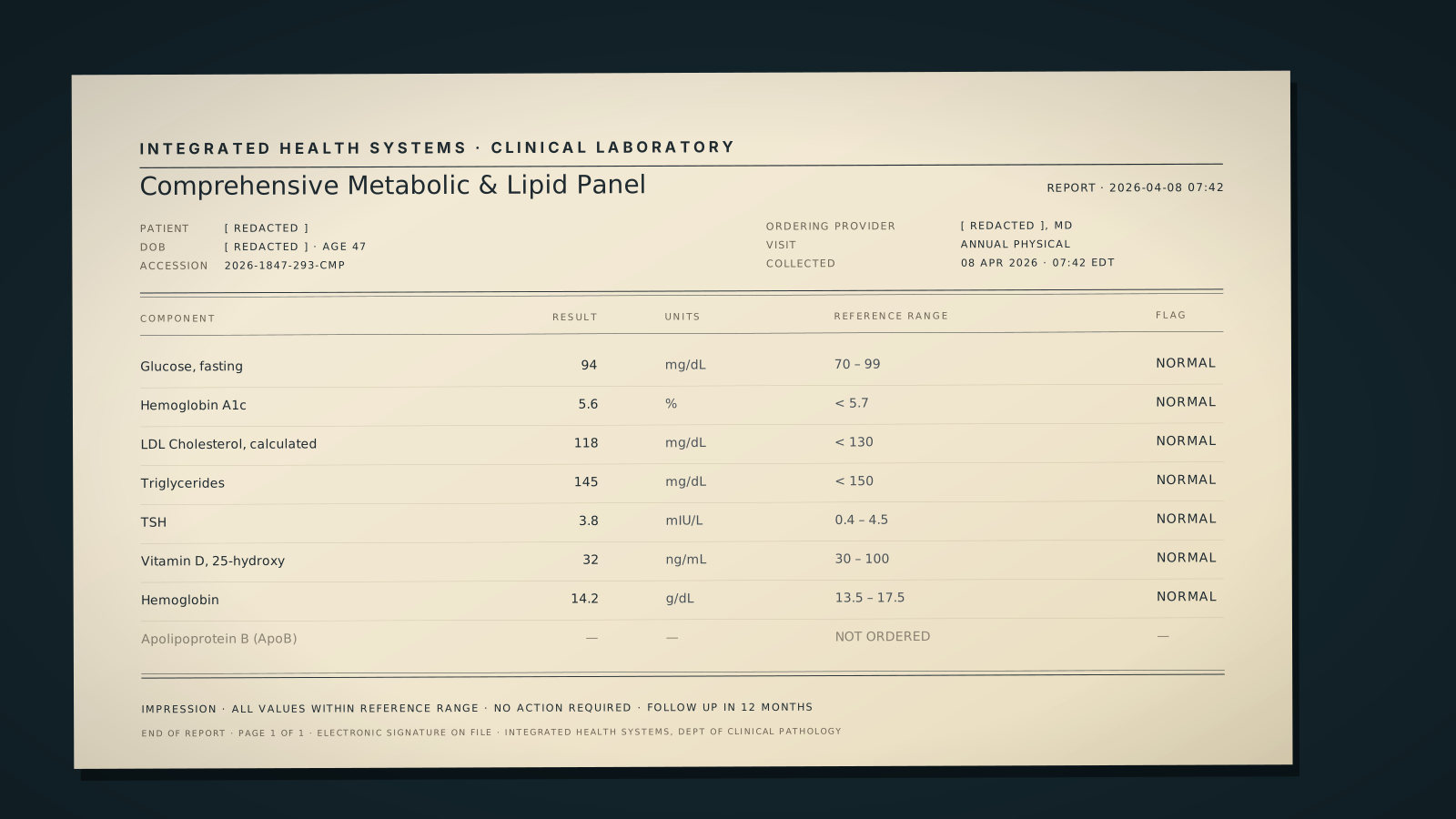
You go to your annual physical. Blood is drawn. A few days later, the results arrive in your patient portal. Next to every number, the same word: Normal.
Your doctor calls. Everything looks fine. See you next year.
But here’s what “normal” actually means in a lab report: your result falls within the reference range. And the reference range is calculated from the middle 95% of the population that happened to use that lab. Not the healthiest 5%. Not the people who will still be healthy at 80. The statistical middle of everyone who walked through the door.
In a country where 38% of adults are prediabetic and 47% have hypertension, “normal” is a low bar. You can be normal and still heading somewhere you don’t want to go.
How reference ranges are built
A clinical reference range is typically the central 95% of values observed in a sample population. The lab draws blood from thousands of people, plots the distribution, cuts off the bottom 2.5% and the top 2.5%, and calls the middle “normal.”
The sample includes healthy 25-year-olds and 70-year-olds with three chronic conditions. People on medications and people who’ve never taken one. Athletes and people who haven’t walked a mile in years. As long as they’re ambulatory enough to get blood drawn, they’re in the pool.
This is how you get a “normal” fasting glucose range that goes up to 99 mg/dL, even though fasting insulin elevation (an early marker of insulin resistance) can appear while glucose is still in the 80s. Or a “normal” LDL-C range extending to 129 mg/dL, despite evidence that atherosclerotic plaque begins forming well below that.
The reference range tells you that you’re not a statistical outlier. Nothing more.
Where normal and optimal diverge
The gap shows up across dozens of biomarkers. Here are the ones where it’s large enough to matter.
Fasting glucose. Normal range is 70-99 mg/dL. Optimal is 72-85. A fasting glucose of 95 is “normal” but often signals early insulin resistance. By the time glucose crosses 100, your pancreas has been overproducing insulin for years. Testing fasting insulin and HOMA-IR, both insulin resistance markers, catches this much earlier. Most annual physicals don’t include them.
ApoB. Normal range varies by lab, often listed as up to 120-130 mg/dL. Optimal is risk-tier dependent, below 80-100 mg/dL for most people. A “normal” ApoB of 115 still means you have more atherogenic particles than recommended by the European Atherosclerosis Society. ApoB is the primary driver of arterial plaque, and it’s a better predictor of cardiovascular events than LDL cholesterol. Protocol’s Cardiovascular Risk protocol uses ApoB, not LDL-C, as the decision driver.
Vitamin D. Normal range is 30-100 ng/mL. Research on bone health, immune function, and muscle performance clusters around 40-60 ng/mL. Have you ever had your vitamin D come back at 32 and heard nothing about it? Technically normal. But you can spend years at a level that nobody flags, feeling slightly worse than you should without knowing why.
Thyroid (TSH). Normal range is 0.4-4.5 mIU/L (some older reference ranges extend to 5.0). A functional target is 0.5-2.5. A TSH of 4.0 is “normal” on paper. But many patients with TSH above 2.5 report fatigue, weight gain, and brain fog, symptoms that improve when TSH is brought lower through lifestyle and, where warranted, clinical intervention. The gap between the lab reference range and where most people feel their best is wide enough to affect daily life for years.
Hemoglobin A1c. Normal range is below 5.7%. Optimal is below 5.4%. An A1c of 5.6% is one tick from a prediabetes diagnosis. Among Protocol’s members, median A1c is 5.35%. The difference between “normal” and “optimal” here is the difference between coasting toward a diagnosis and staying ahead of it.
The same logic applies to triglycerides, ferritin, B12, omega-3 index, and testosterone. In every case, the reference range is wide enough to contain someone who’s genuinely healthy and someone on a slow trajectory toward disease. “Normal” covers both.
Why your doctor uses the reference range
Your doctor isn’t negligent. The system was designed around a different question than the one you’re asking.
You’re asking: Am I healthy? Am I where I should be?
The medical system is asking: Does this patient have a diagnosable condition right now?
The reference range was built for the second question. When your doctor says “normal,” they’re saying “I don’t see a diagnosis here.” They’re not saying “this is where you want to be.”
The 7-minute visit reinforces this. With 2,500 patients and a schedule packed in 15-minute slots, there’s no time to explain that your fasting glucose of 94 isn’t a problem yet but is trending in a direction that warrants a fasting insulin test. The system flags red. Everything else is just not-red.
Insurance makes it worse. If your result is in the reference range, there’s no billing code for “let’s optimize this.” The financial infrastructure of medicine was built around diagnosing and treating disease, not preventing it.
The cost of settling for normal
In a widely cited study of hospitalized MI patients, roughly half had LDL below 100 mg/dL on admission, within what most doctors consider a normal or acceptable range. Their ApoB, a better predictor that most doctors don’t test, told a different story. Years of normal labs can mask a particle count that’s quietly building plaque.
Fasting glucose compounds this. It’s often the last metabolic marker to move. Insulin resistance can build for a decade before glucose finally crosses 100. If nobody tests fasting insulin or HOMA-IR, the first sign of trouble is a prediabetes diagnosis that could have been avoided.
Then there are the deficiencies nobody calls about. A vitamin D of 31 won’t trigger a flag, but it’s associated with impaired immune function and reduced muscle performance. You’ll just feel slightly worse than you should, for years, without any explanation from the lab report.
Among Protocol members, the average biological age measured by Levine PhenoAge (a validated algorithm based on 9 clinical biomarkers plus chronological age) runs 3.8 years younger than their actual age. That gap doesn’t come from normal labs. It comes from optimized ones.
What it looks like when someone actually reads your numbers
Consider what changes when someone actually reads the numbers.
In the 7-minute version, your doctor scans the report. Everything falls within the reference range. “Looks good. Keep doing what you’re doing. Let’s recheck next year.” You leave in 4 minutes.
In the optimization version, a physician and health coach sit down with you for 45 minutes. Your fasting glucose is 92 (normal), but they notice it was 86 two years ago. They order fasting insulin and HOMA-IR to check for early insulin resistance. Your ApoB is 108, within some lab ranges but above the European Atherosclerosis Society recommendation for your risk tier. They explain what that means and start a protocol to bring it down. Your vitamin D is 34, not deficient but not where they want it. They adjust your supplementation with a specific dose and a 3-month recheck.
The data is identical. What changed is who read it.
This is what Protocol’s Foundation Assessment is designed to do. It runs the labs your annual physical skips (ApoB, Lp(a), fasting insulin, HOMA-IR, full nutrient panel, DEXA body composition) and then a physician sits down and explains every number. Not whether it’s in the reference range. Whether it’s where it should be.
The gap is measurable
Protocol’s members have a median ApoB of 79 mg/dL (US population mean: ~95, NHANES). 88% have ApoB below 100. 84% have normal A1c, with an average of 5.35%. Someone looked at those numbers, compared them to evidence-based targets, and built a plan to close the gap. Lifestyle changes where they’re sufficient. Medication when they’re not.
Your labs might be normal. That’s not the same thing as being where you want to be at 60.