

 ← Back to Blog
 The protein prescription: why one number doesn't fit everyone

The protein prescription: why one number doesn’t fit everyone
“Eat more protein” has become the default health advice of the 2020s. And it’s not wrong. Most adults eat less protein than the evidence supports for maintaining muscle mass, strength, and metabolic health.
But “eat more protein” isn’t a prescription. It’s a bumper sticker. How much protein per day for muscle depends on your age, your body composition, and a physiological reality called anabolic resistance, and the targets are more specific than most people realize.
The floor: 1.6 g/kg
The most cited evidence for protein intake and muscle comes from a 2018 meta-analysis published in the British Journal of Sports Medicine by Phillips and colleagues. It pooled 49 randomized controlled trials with 1,817 participants and asked a specific question: at what protein intake does additional protein stop producing additional lean mass gains?
The answer: 1.6 grams per kilogram of body weight per day. Below this threshold, participants left muscle gains on the table. Above it, returns diminished, though they didn’t disappear entirely, with the 95% confidence interval extending to approximately 3.3 g/kg.
This 1.6 g/kg number is the floor for active adults doing resistance training, not the ceiling or even the optimal target.
For a 180-pound (82 kg) person, 1.6 g/kg means 131 grams of protein per day. For a 140-pound (64 kg) person, it’s 102 grams. These aren’t extreme numbers, but they’re substantially more than what most adults consume without deliberate effort.
Why the number changes with age
If 1.6 g/kg is the floor for a 30-year-old, why does Protocol prescribe different targets for a 55-year-old? Because of anabolic resistance.
Anabolic resistance is the age-related decline in your muscles’ sensitivity to protein. When a 25-year-old eats 25 grams of protein, their muscle protein synthesis, the process of building new muscle tissue, ramps up efficiently. When a 60-year-old eats the same 25 grams, the response is blunted. The amino acids arrive, but the signaling cascade that triggers muscle building fires less effectively.
This is a normal feature of aging that begins in your 40s and accelerates after 60, not a pathology. It means older adults need more protein per meal and more total protein per day to achieve the same muscle-building stimulus that younger adults get at lower intakes.
Two research bodies define the evidence base for older adults. The PROT-AGE study group (Bauer et al., 2013) recommended 1.0-1.2 g/kg for healthy older adults and 1.2-1.5 g/kg for those with acute or chronic disease. ESPEN, the European Society for Clinical Nutrition and Metabolism (Deutz et al., 2014), pushed higher, recommending 1.0-1.5 g/kg for healthy older adults and explicitly noting that active older adults engaged in resistance training likely need more.
Protocol synthesizes this evidence into age-stratified targets that account for both the Phillips meta-analysis floor and the PROT-AGE/ESPEN guidance for older adults.
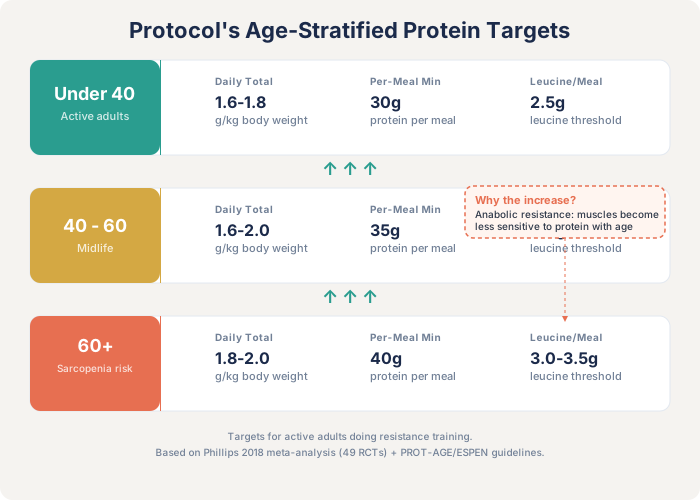
Protocol’s age-stratified protein targets
Active adults under 40
Target 1.6-1.8 g/kg daily, with at least 30 grams per meal and 2.5 grams of leucine per meal.
Anabolic resistance is minimal at this age. The 1.6 g/kg floor from the Phillips meta-analysis applies directly. The upper end (1.8 g/kg) is for people in aggressive hypertrophy phases or cutting, where higher protein helps preserve lean mass.
Active adults 40-60
Target 1.6-2.0 g/kg daily, with at least 35 grams per meal and 3.0 grams of leucine per meal.
Anabolic resistance is emerging in this range. The per-meal minimum rises from 30 to 35 grams because a larger amino acid bolus is needed to trigger the same muscle protein synthesis response. Leucine, the amino acid that most directly activates the mTOR pathway for muscle building, needs to reach 3.0 grams per meal to do its job.
Adults 60+ or at sarcopenia risk
Target 1.8-2.0 g/kg daily, with at least 40 grams per meal and 3.0-3.5 grams of leucine per meal.
Anabolic resistance is most pronounced here. The floor moves up to 1.8 g/kg, and per-meal targets rise to 40 grams because smaller doses simply don’t trigger adequate muscle protein synthesis in this age group. Leucine requirements increase accordingly.
These are targets for people actively doing resistance training. Sedentary older adults still benefit from higher protein intake, but the targets assume the combination of training stimulus plus nutrition, because one without the other produces limited results.
The BMI adjustment
If your BMI is above 30, using actual body weight to calculate protein targets produces unreasonably high numbers. A 250-pound person at 5’9” would need 181 grams of protein at 1.6 g/kg, achievable but inflated because a large portion of that body weight is adipose tissue, not metabolically active muscle.
Protocol uses ideal body weight (Hamwi formula) for protein calculations when BMI exceeds 30:
- Men: 106 lbs for the first 5 feet + 6 lbs per additional inch
- Women: 100 lbs for the first 5 feet + 5 lbs per additional inch
This gives you a protein target based on the body mass you’re building and maintaining, not the total mass you’re carrying. The 250-pound person at 5’9” has an ideal body weight of approximately 160 pounds (73 kg), which gives a more reasonable target of 117-131 grams at 1.6-1.8 g/kg.
Per-meal distribution: why it matters more than daily total
The most common protein mistake isn’t eating too little, it’s eating the right daily amount in the wrong pattern. People hit their number by back-loading most of it into dinner.
Take a realistic day: 20 grams at breakfast (yogurt and granola), 20 at lunch (salad with some chicken), 20 at a snack, 60 at dinner. That’s 120 grams total, which is close to the floor for a 75 kg person. But three of those four meals did almost nothing for muscle.
Muscle protein synthesis has a threshold effect. Below a certain amount of protein in a single meal, the synthesis response is minimal. Above that threshold, it activates fully and stays elevated for approximately 2-3 hours before returning to baseline.
For a person under 40, that threshold is approximately 30 grams. For someone over 60, it’s closer to 40 grams.
In the pattern above, the 20-gram meals at breakfast, lunch, and snack time are below the threshold. Only dinner hits it. That person gets one full muscle protein synthesis stimulus per day when they could be getting three or four.
120 grams spread as 30-30-30-30 across four meals produces more muscle protein synthesis over 24 hours than 20-20-20-60 at the same total.
Protocol tracks per-meal protein, not just daily protein, for this reason.
Leucine: the trigger amino acid
Not all protein drives muscle building equally. The variable that matters most is leucine content.
Leucine is one of three branched-chain amino acids, and the one that most directly activates mTOR, the molecular switch for muscle protein synthesis. The leucine threshold is the minimum amount per meal needed to fully activate this pathway.
Where leucine shows up in food:
- Chicken breast (6 oz): ~3.5 g leucine
- Greek yogurt (1 cup): ~1.5 g leucine
- Eggs (3 large): ~1.6 g leucine
- Whey protein (25 g scoop): ~2.5-3.0 g leucine
- Tofu (6 oz): ~1.2 g leucine
Food choice within the protein category matters. A 30-gram protein meal from chicken breast delivers more leucine than a 30-gram protein meal from legumes. For older adults who need 3.0-3.5 grams of leucine per meal, this distinction is practically important, some protein sources require much larger portions to hit the leucine threshold.
How to start
Protocol doesn’t drop a 180-gram daily target on you and walk away. The approach is titration: start at the floor for your age group, track for 2-4 weeks, assess adherence and digestive tolerance, then step up if needed.
The first two weeks are usually diagnostic. Audit actual intake using Cronometer or MacroFactor. Most people find they’re 30-50% below target, and the surprise isn’t that they’ve been skimping, it’s that modern meals just default to carbohydrate-heavy without much deliberate choice.
Weeks three and four, restructure meals to hit per-meal minimums. Breakfast is usually where people fall shortest; adding protein there has more impact than tweaking dinner. Dinner tends to take care of itself.
After that, if the daily total is still low after fixing meal structure, add a targeted protein source, a whey shake, extra Greek yogurt, an additional egg. The goal is to reach the target in a way that doesn’t feel like a diet.
Creatine: the one supplement with grade a evidence
Creatine monohydrate earns a section here. It’s the most studied supplement in sports nutrition, and the evidence is unusually consistent.
The International Society of Sports Nutrition (ISSN) position stand (Kreider et al., 2017) gives creatine its highest evidence grade. The data: creatine supplementation at 3-5 grams per day increases intramuscular phosphocreatine stores, improves high-intensity exercise capacity, and augments lean mass gains from resistance training. The effect is consistent across age groups, including older adults.
Creatine isn’t a protein substitute. It works through a different mechanism, replenishing the ATP-PCr energy system used in short-burst efforts like lifting heavy. It’s additive to adequate protein intake, not a replacement for it.
Protocol includes creatine monohydrate in its Muscle & Body Composition protocol for members whose assessment indicates it’s appropriate. The form matters: monohydrate specifically, not hydrochloride, ethyl ester, or buffered variants. Monohydrate has the evidence behind it.
How protein connects across protocols
Protein targets connect to everything else. Your prescription ties directly to your DEXA results (Protocol 2): if ASMI is below the 25th percentile for your age, protein targets move to the upper end of the range. It ties to your exercise programming (Protocol 4) too, because resistance training without adequate protein underdelivers, and protein without a training stimulus is similarly incomplete.
And it connects to metabolic health (Protocol 3). Protein anchoring, starting each meal with protein before carbohydrates, is one of Protocol’s CGM-guided dietary strategies. For some members, simply reordering their meal (protein first, vegetables second, starches third) reduces post-meal glucose spikes by 20-40% without changing what they eat, a finding consistent with controlled studies on meal sequencing.
The monitoring, tracking per-meal protein, watching DEXA-measured lean mass changes, adjusting targets based on response, is what separates a protein protocol from protein advice.
Want a protein prescription calibrated to your age, body composition, and goals? Book a Discovery Call to learn how Protocol builds and monitors your nutrition targets.