

 ← Back to Blog
 The Problem with Supplements Nobody Tests For

The Problem with Supplements Nobody Tests For
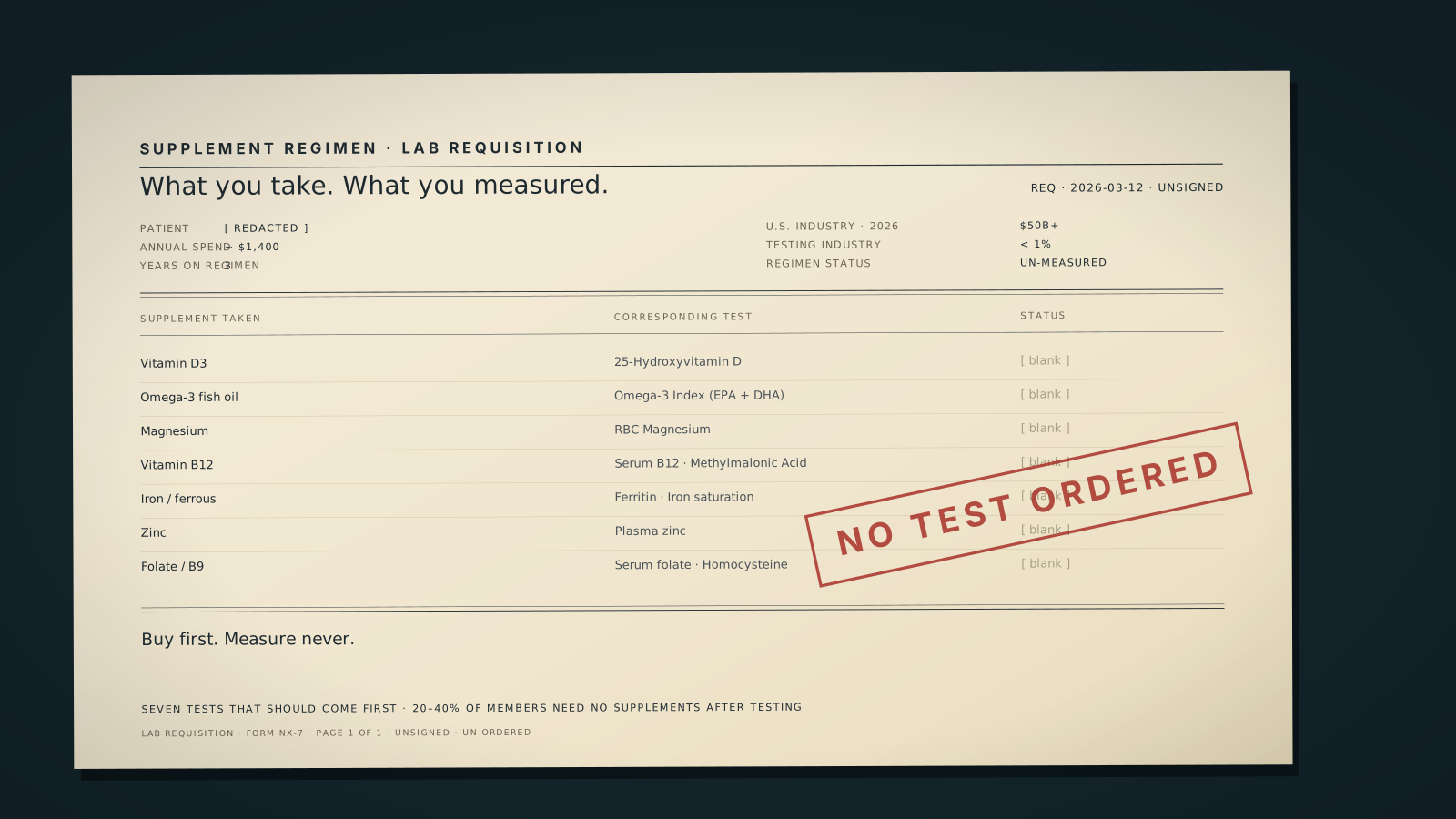
The U.S. supplement industry generates over $50 billion a year. The testing industry for whether you actually need those supplements generates almost nothing.
That gap reflects the current state of supplementation: buy first, measure never. The average American taking supplements has never tested a single biomarker related to what they’re taking. They chose based on a podcast, an Amazon review, or a vague sense that they “probably should be” taking vitamin D.
Protocol’s Nutrient Optimization program starts from the opposite direction. Test first. Find out what is actually low, what is adequate, and what is already optimal. Then, and only then, decide whether a supplement makes sense.
About 20-40% of members turn out to need no supplements at all.
The 7 tests that should come before any supplement
Protocol tests every member against a standard panel, seven biomarkers where deficiency is common enough and the health consequences documented enough that skipping the test makes no clinical sense.
1. 25-Hydroxyvitamin D (25(OH)D) Target: 40-60 ng/mL. The conventional “sufficient” threshold of 30 ng/mL was set to prevent rickets, not to support immune function, mood, or musculoskeletal health. Most adults without supplementation land between 15-30 ng/mL.
2. Omega-3 Index Target: 8-12%. This measures EPA and DHA as a percentage of red blood cell membrane fatty acids, a stable marker that reflects roughly the past 90-120 days. Most Americans sit at 4-5%. Below 4% is associated with the highest cardiovascular risk.
3. RBC Magnesium Target: 4.2-6.0 mg/dL. Not serum magnesium, which is what most doctors order. Serum magnesium stays normal until tissue stores are severely depleted, because the body tightly regulates serum levels for cardiac function. RBC magnesium catches depletion earlier.
4. Homocysteine Target: below 10 umol/L (optimal below 7). Elevated homocysteine is an independent cardiovascular risk factor and signals a problem in B-vitamin metabolism. When it is high, the next question is which bottleneck: B12, folate, or B6.
5. Ferritin Target: 30-100 ng/mL (women), 30-200 ng/mL (men). Ferritin reflects iron stores. Too low causes fatigue, poor exercise capacity, and restless leg syndrome. Too high suggests iron overload, which carries its own cardiovascular risk. Both directions matter, and supplementing iron without a confirmed deficiency is a specific stop-flag.
6. Vitamin B12 Target: 300-900 pg/mL. Deficiency is common in older adults, anyone on metformin or proton pump inhibitors, and anyone eating a plant-based diet. Symptoms (fatigue, brain fog, tingling) are nonspecific enough that deficiency often goes undetected until it is advanced.
7. Folate Target: above 10 ng/mL. Folate works with B12 to keep homocysteine in check. When both are low, homocysteine rises. Correcting one without the other only half-solves the problem.
Total cost for this panel: approximately $200-325. That is less than most supplement users spend in two months on products they have never verified they need.
Food first, supplements second
Protocol does not hand you a bottle on day one. Finding a low number is the beginning of a process, not permission to order from Amazon.
A registered dietitian works with each member on specific food targets: fatty fish and egg yolks for vitamin D, dark leafy greens and pumpkin seeds for magnesium, more oily fish for omega-3s. The member lives with those changes for 8-12 weeks, then retests. For someone starting from mildly low levels, food alone often closes the gap.
Supplementation comes in only when food-first is not enough, or when the deficiency is severe enough that waiting eight weeks is not reasonable. When a supplement does enter the picture, it has to carry USP, NSF for Sport, or ConsumerLab verification. Then another retest at 8-12 weeks. The point is to confirm the supplement is actually working, not just to feel like you are doing something.
The food-first sequence exists because whole-food sources come with cofactors, fiber, and absorption contexts that isolated supplements do not replicate. And because many people are already getting enough from food. They just never checked.
The supplement audit: keep, stop, change
Every new Protocol member brings in what they are currently taking. The average member arrives with 6-10 supplements. Each one gets reviewed against the test results and sorted: keep, stop, or change the form.
Keep is for anything that addresses a confirmed deficiency, has actual evidence behind it, and is third-party verified. Stop is for anything without a deficiency to address: poor quality, weak evidence, or duplicating something else in the stack. Change is for the right nutrient in the wrong form: magnesium oxide to glycinate for better absorption, ethyl ester fish oil to triglyceride form (studies show roughly 25-50% better bioavailability depending on meal timing), folic acid to methylfolate for members who need it.
Most members leave with 3-5 supplements where they came in with 6-10.
Five things you should probably stop taking
The audit turns up the same candidates over and over, supplements that appear in most medicine cabinets but fail the evidence test for anyone without a confirmed deficiency.
Generic multivitamins. A multivitamin contains small amounts of many nutrients, often in poorly absorbed forms. If you have a specific deficiency, the dose in a multivitamin is usually too low to correct it. If you do not have a deficiency, you do not need it. It is the supplement equivalent of spraying a garden hose across the whole yard when only one plant needs water.
Calcium supplements without vitamin K2. Calcium supplementation without K2 may increase calcium deposition in arterial walls rather than in bone. K2 in MK-7 form directs calcium toward bone and away from soft tissue. Dietary calcium from food is preferred over supplements where possible; if you supplement calcium, K2 is the required co-factor.
High-dose antioxidant isolates. Two large randomized trials found that beta-carotene supplementation increased lung cancer risk in smokers. High-dose vitamin E (above 400 IU per day) showed increased all-cause mortality in multiple meta-analyses. Antioxidants from food appear protective. The same molecules concentrated in pill form do not behave the same way.
Iron without confirmed deficiency. Iron is one of the few nutrients where excess is clearly harmful. Iron overload contributes to oxidative stress and organ damage. Supplementing “just in case” is not a neutral decision. Test ferritin first. If it is in range, there is no case for iron.
Folic acid when methylfolate is available. Folic acid requires enzymatic conversion to its active form, 5-MTHF. People with MTHFR C677T variants convert poorly, leaving unmetabolized folic acid in circulation. If folate supplementation is indicated, methylfolate bypasses the conversion step entirely.
Quality is not optional
The supplement industry in the United States operates under looser regulation than pharmaceuticals. A product can reach the shelf without proving it contains what the label claims, at the dose the label states, free of contaminants.
Third-party testing fills this gap. Protocol accepts one of three certifications: USP (United States Pharmacopeia), which tests identity, potency, purity, and dissolution; NSF International, which tests for contaminants and banned substances; or ConsumerLab, which publishes independent test results. The brand name on the front of the bottle is marketing. The certification seal on the back is what matters.
When supplements do make sense
This is not an anti-supplement argument. It is an argument against supplementing blind.
Supplements make sense when a measured deficiency cannot be corrected by food alone within a reasonable timeframe. A vegan who cannot get B12 from diet needs supplementation, and that is not debatable. Someone with a 25(OH)D of 15 ng/mL in January in Boston needs vitamin D3 while they improve dietary sources. A member with an Omega-3 Index of 3% who eats fish once a month needs EPA/DHA.
In every case, the decision starts from a number. A measured value. A confirmed gap between where you are and where the evidence says you should be.
When supplementation is indicated, the form matters: cholecalciferol over ergocalciferol, triglyceride-form fish oil over ethyl ester, magnesium glycinate over oxide. So does the dose, titrated to your actual deficit, not a generic recommendation. So do the cofactors: K2 with D3 above 2,000 IU, vitamin C with iron. And so does verified quality.
For more on the three most common deficiencies and how to address them, read Vitamin D, Omega-3, and Magnesium: The Three Deficiencies Almost Everyone Has. For the finding that many members arrive over-supplemented, read Why 20-40% of Our Members Need No Supplements.
The $50 billion question
The supplement industry profits from uncertainty. If you do not know whether you are deficient, the default is to supplement just in case. The industry earns $50 billion a year from that logic.
Testing costs $200-325. It replaces uncertainty with data: what to take, what to stop, what was never necessary. It turns a $200/month supplement habit into a $40/month targeted protocol, or for 20-40% of people, into nothing at all because they were already sufficient.
Most people start by asking which supplements to take. That is the wrong starting point. The question that needs to come first is what you are actually deficient in, and that requires a number, not a guess.
Ready to find out where you stand? Protocol’s Foundation Assessment measures what your annual physical misses (ApoB, HOMA-IR, DEXA body composition, VO2 max) and builds a specific action plan from the data.
Related Content
Nutrient Optimization→