

 ← Back to Blog
 Your ApoB is high: a step-by-step guide to what happens next

Your ApoB is high: a step-by-step guide to what happens next
You got a blood test back. Maybe you specifically asked for ApoB. Maybe a doctor ordered it as part of an advanced lipid panel. Either way, the number came back above 100 mg/dL, and now you’re trying to figure out what that means and what you’re supposed to do about it.
This isn’t the post that tells you to eat more fiber and hope for the best. Here’s the actual protocol: what ApoB is, why it matters more than LDL, how your specific target gets set, and what it takes to bring the number down.
Step 1: what ApoB actually is
ApoB, apolipoprotein B, is a protein. Every atherogenic lipoprotein in your blood carries exactly one molecule of it. Atherogenic lipoproteins are the particles that penetrate arterial walls and initiate plaque formation: LDL particles, VLDL remnants, IDL particles, and Lp(a) particles. One particle, one ApoB.
That makes ApoB a direct particle count. Particle count, more than cholesterol content alone, is what drives atherosclerosis. The number of particles determines how many opportunities exist for arterial wall penetration; what each particle carries is secondary.
LDL-C, the number most people know, estimates the amount of cholesterol riding inside LDL particles. Two people with identical LDL-C can have dramatically different particle counts. One might have fewer large particles. The other might have many small, dense ones. Same LDL-C number. Very different ApoB.
An ApoB above 100 mg/dL means you have a high concentration of atherogenic particles in circulation. Each one can cross into the arterial wall and add to plaque burden. The longer it stays elevated, the more cumulative exposure your arteries absorb, and both how high and how long are what determine cardiovascular risk.
Step 2: your specific target
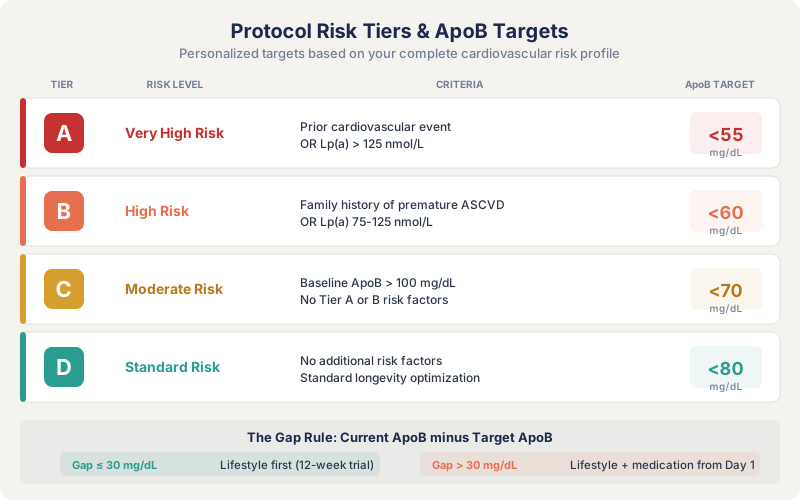
Not everyone with a high ApoB needs the same target. Someone with additional risk factors needs to get lower to achieve the same protection. Here’s how the tiers work:
Tier a, very high risk | ApoB target: below 55 mg/dL
You’re assigned Tier A if:
- You’ve had a prior cardiovascular event (heart attack, stroke, stent, bypass)
- Your Lp(a), lipoprotein(a), a genetically determined particle, is above 125 nmol/L
Lp(a) is tested once because it’s genetic and doesn’t change. If yours is above 125, your tier escalates regardless of everything else. At this level of risk, medication starts alongside lifestyle work rather than after a 12-week trial period of lifestyle alone.
Tier b, high risk | ApoB target: below 60 mg/dL
You’re assigned Tier B if:
- You have a family history of premature atherosclerotic cardiovascular disease (heart attack or stroke in a first-degree male relative before 55, or female relative before 65)
- Your Lp(a) is between 75 and 125 nmol/L
Family history of premature ASCVD is one of the strongest risk signals in cardiovascular medicine. If your father had a heart attack at 50, your target changes.
Tier c, moderate risk | ApoB target: below 70 mg/dL
You’re assigned Tier C if:
- Your baseline ApoB is above 100 mg/dL
- You don’t meet Tier A or Tier B criteria
If your ApoB came back above 100 and you don’t have the Tier A or B risk factors, Tier C is likely where you land. Below 70 is the target, a real reduction from 100+, but one that’s achievable with the right protocol.
Tier d, standard risk | ApoB target: below 80 mg/dL
You’re assigned Tier D if:
- None of the above risk factors apply
Tier D members still get ApoB optimization. An ApoB of 80 is better than 100, even without added risk factors, because atherosclerosis accumulates over decades. Lower particle exposure now means less plaque later.
What we don’t use for risk Tier assignment
Not every test marketed as “advanced” adds value. A few worth noting:
- CIMT (carotid intima-media thickness) is not part of the protocol. Multiple analyses and updated guidelines found it adds nothing to cardiovascular risk prediction beyond standard lipid markers.
- LDL-P (LDL particle number) is redundant with ApoB. ApoB counts all atherogenic particles, not just LDL, so it captures more with one test.
- Oxidized LDL isn’t standardized across labs. A result from one lab can’t be compared to a result from another, which makes it unreliable for clinical decisions.
Step 3: the gap calculation
Subtract your target from your current ApoB.
Example 1: Your ApoB is 110. Your target (Tier C) is 70. Gap = 40. Example 2: Your ApoB is 105. Your target (Tier D) is 80. Gap = 25.
The gap determines your treatment path:
Gap of 30 or less: lifestyle first
A gap of 30 mg/dL or less is where lifestyle has a realistic chance of closing the distance on its own. You get 12 weeks to find out.
Those 12 weeks involve dietary changes that specifically target ApoB (not generic “eat healthy”), exercise that addresses lipid metabolism, targeted supplementation where evidence supports it, and coached accountability. The last part matters more than it sounds, knowing what to do and actually doing it consistently are not the same thing.
At 12 weeks, ApoB gets rechecked. Hit your target and lifestyle modifications become your ongoing protocol with regular monitoring. Don’t hit it and pharmacotherapy enters the picture.
Gap greater than 30: pharmacotherapy plus lifestyle from day one
A gap above 30 mg/dL is where lifestyle alone runs out of road. Asking someone with an ApoB of 130 and a target of 70 to close 60 points through diet and exercise is setting them up for 12 weeks of continued high arterial exposure, followed by the medication they needed from day one.
When the gap exceeds 30, both tracks start simultaneously. This isn’t a failure of willpower, it’s just arithmetic. The biology doesn’t support lifestyle-only when the distance is that large.
Step 4: what medication looks like
Here’s the typical escalation when pharmacotherapy is part of the plan:
First line: statins
Statins reduce ApoB by 30-50% depending on the drug and dose. The mechanism: statins reduce the liver’s cholesterol production, which prompts the liver to pull more LDL particles out of circulation, dropping particle count.
The CTT meta-analysis, the largest pooled analysis of statin trials conducted, found equal efficacy in men and women. There’s a persistent belief that statins work less well for women; the data doesn’t support it.
Side effects are real but less common than the reputation suggests. Patient surveys and observational data put muscle symptoms around 5-10%, but blinded randomized trials, where patients don’t know whether they’re on a statin, show rates closer to 1-5%. Most resolve with a different statin or a lower dose.
Second line: ezetimibe
When a statin alone doesn’t reach the target, ezetimibe gets added. It blocks cholesterol absorption in the intestine, producing roughly an additional 15-20% reduction in ApoB on top of the statin. Once daily, well-tolerated, and it’s been around long enough that its safety profile is well characterized.
Third line: PCSK9 inhibitors
For members who need further reduction, or who can’t tolerate statins, PCSK9 inhibitors are injectable medications given every 2-4 weeks. As monotherapy they can reduce ApoB by 50-60%; added on top of statin and ezetimibe, the additional reduction is typically 40-55%. Highly effective, but typically reserved for Tier A and Tier B members, or anyone who can’t hit their target on the first two lines.
The sequence is deliberate. Start with the most established, best-tolerated option. Add the next layer only if needed. Recheck ApoB at each step.
Step 5: lifestyle changes that actually move ApoB
Not all lifestyle advice does the same thing. Here’s what the evidence actually shows for ApoB specifically:
Reducing saturated fat has the most consistent impact. The specific move is replacing saturated fat with unsaturated fat, not with refined carbohydrates, which doesn’t help and may make things worse. Soluble fiber (oats, legumes, psyllium) binds bile acids and prompts the liver to pull more LDL particles from circulation; 10-25 grams per day can lower ApoB by around 5-10%. Plant sterols and stanols work by a similar mechanism to ezetimibe but with a smaller effect, 2 grams per day adds roughly another 5-10% reduction.
Aerobic exercise improves lipid metabolism broadly. The specific effect on ApoB is modest, typically 5-10%, but it compounds with the dietary changes and does real work for overall metabolic health. 150+ minutes of moderate-intensity cardio per week is the threshold where the data gets consistent.
What doesn’t move the needle much: generic “eat healthy” advice without specific targets, cholesterol supplements with no ApoB evidence behind them, and extreme dietary protocols you can’t maintain past a few weeks.
Step 6: the timeline
ApoB responds to intervention in 6-12 weeks, whether the intervention is lifestyle or pharmacotherapy. That’s genuinely useful, it means you don’t have to wait a year to find out if something is working.
At 12 weeks, either your ApoB is moving toward the target or it isn’t. If it is, you stay the course. If it isn’t, the plan adjusts: next layer of pharmacotherapy, or a closer look at the lifestyle modifications that aren’t producing what was expected.
This is not a “check again in a year” approach. Twelve weeks. Measure. Adjust. Repeat.
What this looks like at Protocol
The Cardiovascular Risk protocol is built around this sequence. Every member gets ApoB at baseline alongside Lp(a), a standard lipid panel, and any additional markers warranted. Risk tier assignment follows. Then gap calculation, treatment path, a specific coached protocol, and a 12-week recheck with adjustment based on what the numbers show.
Not a pamphlet. Not “eat better and come back in six months.”
Protocol members who complete the Cardiovascular Risk protocol see ApoB optimal attainment go from 27% at baseline to 69%. The difference is specific targets, coached interventions, and 12-week checkpoints, not annual physicals and hoping the number moves on its own.
The difference between knowing and doing
You now know more about ApoB than most people who get a high result back. You know what sets your target, how the gap calculation works, what the medication options are and in what order, and which lifestyle changes have actual evidence.
Most people stall between knowing this and acting on it. They read the post, feel like something got handled, and go back to waiting for their next annual physical. The number stays where it is. The arterial exposure keeps accumulating.
Acting means getting your risk tier assigned by someone who actually uses this framework, with a specific target and a 12-week checkpoint to measure against.
Ready to get a specific plan for your ApoB? Book a Discovery Call and we’ll assign your risk tier, calculate your gap, and build the protocol to close it.
Related Content
Cardiovascular Risk→