

 ← Back to Blog
 Your doctor said your cholesterol is borderline: here's what that actually means
Your doctor said your cholesterol is borderline: here’s what that actually means
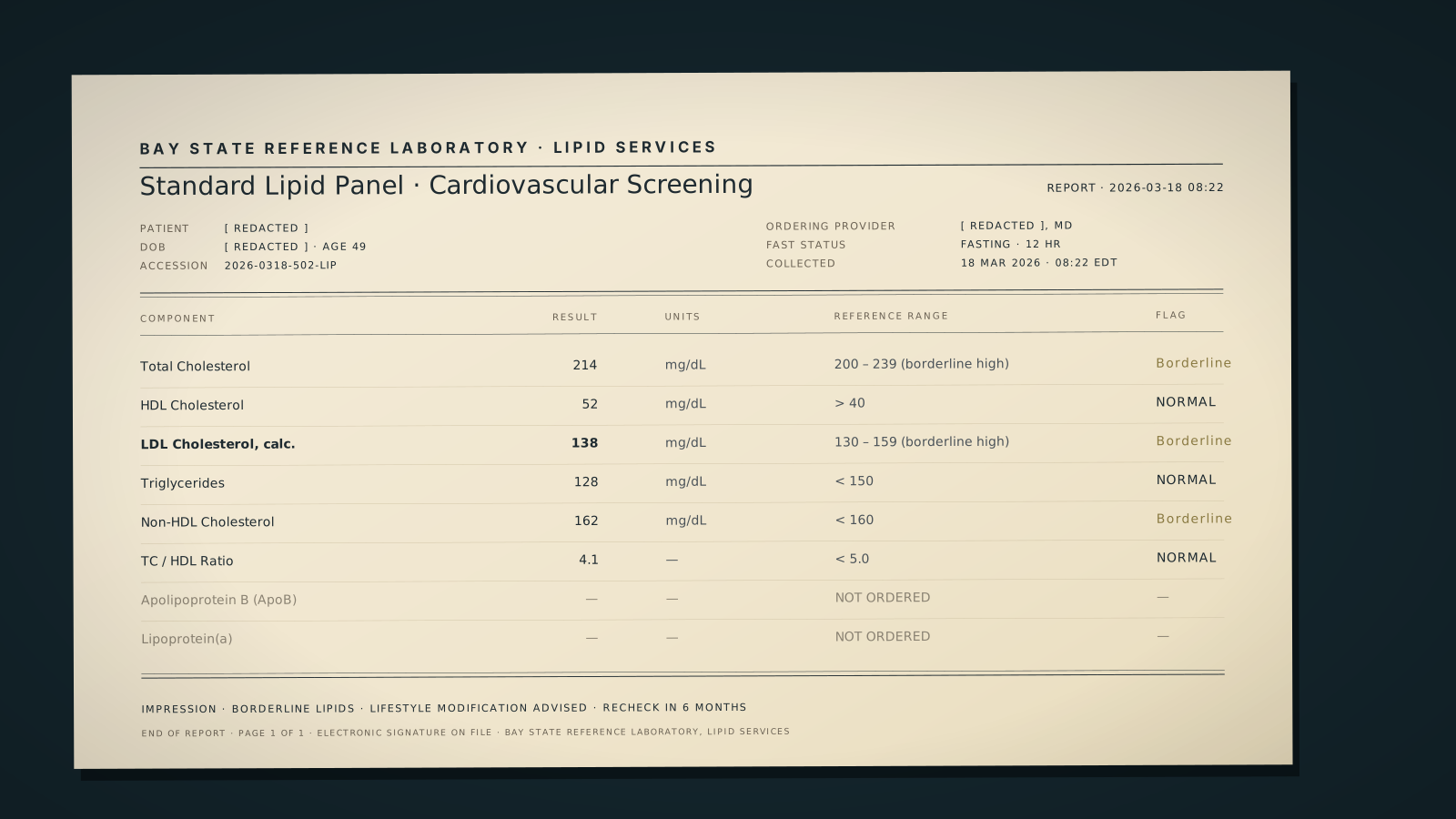
You left your annual physical with a printout. Your doctor circled a number, said “your cholesterol is borderline,” and told you to watch your diet. Maybe exercise more. Come back in six months.
That word, borderline, is doing a lot of heavy lifting. It sounds manageable. Like you’re close to fine. But borderline cholesterol, as most doctors define it, tells you almost nothing about whether plaque is building in your arteries right now.
The problem: the number your doctor circled is almost certainly LDL-C. And LDL-C is the wrong measurement for determining your actual cardiovascular risk.
The number on your lab report is an estimate
LDL-C, the “bad cholesterol” number on a standard lipid panel, is not a direct measurement. It’s calculated using a formula that estimates how much cholesterol is carried inside LDL particles. An LDL-C of 130 mg/dL means there are roughly 130 milligrams of cholesterol per deciliter of blood riding inside those particles.
But cholesterol doesn’t damage arteries. Particles do.
The particles that cause atherosclerosis (the buildup of plaque inside arterial walls) are called atherogenic lipoproteins. Every single one carries exactly one molecule of a protein called ApoB, apolipoprotein B. One particle, one ApoB. That makes ApoB a direct count of every particle in your blood that can penetrate an artery wall and start the process that leads to heart attacks and strokes.
Think of it this way: LDL-C tells you how much cargo the trucks are carrying. ApoB tells you how many trucks are on the road. It’s the truck count, not the cargo weight, that determines how many crash into arterial walls.
Why “borderline” LDL can be misleading in both directions
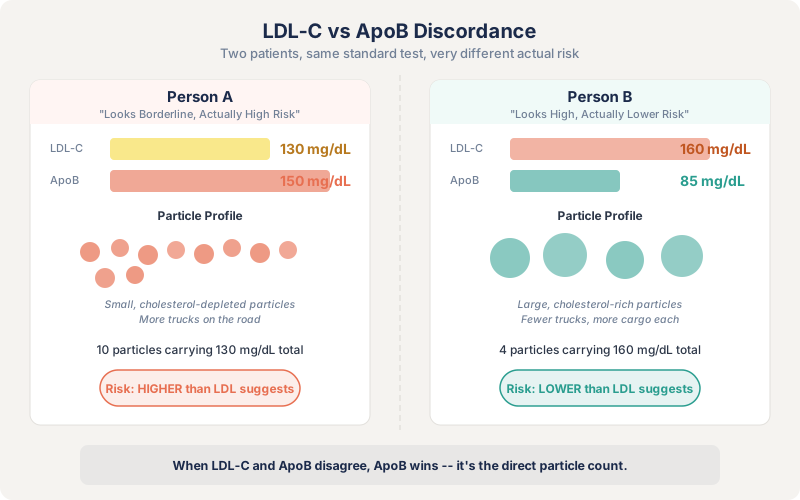
LDL-ApoB discordance is the clinical term for what happens when these two measurements point in different directions. They don’t always agree. When they disagree, ApoB wins, because ApoB is the actual causal measurement.
Scenario 1: LDL looks borderline, but your risk is higher than it appears. Your LDL-C comes back at 130 mg/dL. Borderline. Your doctor isn’t alarmed. But if your ApoB is 150 mg/dL, you have far more atherogenic particles circulating than the LDL-C suggests. This happens when LDL particles are small and cholesterol-depleted: each one carries less cholesterol, so the cholesterol-based estimate undercounts the particles. The “borderline” label is wrong.
Scenario 2: LDL looks elevated, but your risk is lower than the number implies. Your LDL-C is 160 mg/dL. Your doctor is concerned, starts talking about statins. But your ApoB is 85 mg/dL, meaning you have fewer atherogenic particles than the LDL number suggests. Your particles are large and cholesterol-rich. LDL-C overestimates the actual burden.
In both cases, LDL-C tells one story. ApoB tells the accurate one.
50% Of heart attacks happen in people with “normal” cholesterol
This isn’t theoretical. Roughly half of all heart attacks occur in people whose LDL cholesterol was within the “normal” range at the time of their hospitalization. Their doctors had told them their numbers looked fine. Plaque built anyway.
If half the people having heart attacks had numbers that didn’t raise a flag, the flag is wrong.
ApoB accounts for most of that gap. When LDL-C and ApoB point in the same direction, LDL-C works as a reasonable proxy. But in the roughly 20–30% of people where they diverge, ApoB is the better predictor of who will develop cardiovascular disease.
What your ApoB number actually tells you
ApoB is measured in milligrams per deciliter, just like LDL-C. But the targets are different, and they depend on your individual risk profile.
At Protocol, we assign every member to a cardiovascular risk tier based on their full clinical picture, not just one number in isolation. Those tiers determine your ApoB target:
- Tier A (Very High Risk): ApoB below 55 mg/dL. Prior cardiovascular event, or Lp(a) above 125 nmol/L.
- Tier B (High Risk): ApoB below 60 mg/dL. Family history of premature cardiovascular disease, or Lp(a) between 75–125 nmol/L.
- Tier C (Moderate Risk): ApoB below 70 mg/dL. Baseline ApoB above 100 mg/dL.
- Tier D (Standard Risk): ApoB below 80 mg/dL. No additional risk factors.
These are real numbers to hit, not vague guidance to “watch your diet.” You know exactly where your ApoB needs to be, and you can see the gap between where you are and where you’re going.
The gap rule: when lifestyle alone won’t get you there
Once you know your current ApoB and your target ApoB, you can calculate the gap. That gap drives everything.
If the gap is 30 mg/dL or less (say your ApoB is 95 and your target is 80), lifestyle changes are the first move. Diet, exercise, and targeted supplementation can lower ApoB by up to 20–30 mg/dL in people who respond well. You make those changes and recheck in 12 weeks.
If the gap is greater than 30 mg/dL (say your ApoB is 130 and your target is 70), lifestyle alone almost certainly won’t close it. Pharmacotherapy starts alongside lifestyle changes from day one. Waiting 12 weeks to “try diet first” when the gap is 60 points means 12 more weeks of elevated particle exposure to your arterial walls. That’s time you don’t get back.
The gap rule gets rid of “borderline” as a clinical concept. There’s no borderline anymore. There’s a number, a target, and a distance. The distance determines the intervention.
Why most doctors still use LDL-C
This isn’t a critique of your doctor. LDL-C has been the standard lipid measurement for decades, it’s what medical schools teach, it’s what guidelines have historically referenced, and it’s on every standard panel for essentially no added cost. In many cases it’s a reasonable approximation.
But reasonable approximation isn’t accurate measurement. Atherosclerotic cardiovascular disease is the leading cause of death globally. At that level of stakes, approximation matters.
ApoB testing is widely available. Most major labs run it. It’s increasingly covered by insurance. And it gives you the actual particle count that LDL-C cannot consistently provide.
What “proactive” actually looks like
The standard approach to borderline cholesterol is reactive: wait until numbers get worse, then intervene. Check again in six months. Maybe a year.
A proactive approach measures ApoB at baseline, assigns a risk-appropriate target, calculates the gap, and acts on day one. It rechecks in 6–12 weeks, because that’s how quickly ApoB responds to both lifestyle changes and pharmacotherapy. It doesn’t wait for plaque to become symptomatic. It doesn’t rely on a word like “borderline.”
At Protocol, our Cardiovascular Risk protocol does exactly this. Every member gets an ApoB measurement at baseline. Risk tier assignment is based on the full clinical picture: Lp(a), family history, and coronary artery calcium scoring where appropriate. You get a precise number to hit, a timeline, and follow-up that’s coached rather than just scheduled.
So what should you do?
“Borderline cholesterol” is a label that sounds reassuring and communicates almost nothing. What actually matters is your ApoB, a direct count of the particles building up in your arteries, and how far that number sits from where it needs to be. A small gap means you try lifestyle first. A large one means you don’t wait.
If your doctor told you your cholesterol is borderline, the right next step isn’t waiting six months. It’s getting an ApoB, assigning a target, and building a plan to reach it.
Ready to find out where you actually stand? Book a Discovery Call and we’ll walk through your numbers, assign your risk tier, and build your plan.
Related Content
Cardiovascular Risk→