

 ← Back to Blog
 The ApoB-Lp(a) connection: why these two numbers predict heart disease better than LDL

The ApoB-Lp(a) connection: why these two numbers predict heart disease better than LDL
Most adults in the United States have had their LDL cholesterol measured. Very few have had their ApoB measured. Even fewer have had their Lp(a) measured. And almost no one has had both ApoB and Lp(a) interpreted together, which is where the real risk picture lives.
ApoB (apolipoprotein B) counts every atherogenic particle in your blood. Lp(a), or lipoprotein(a), tells you whether a large fraction of those particles is genetically fixed and won’t respond to lifestyle changes. Together, they reclassify cardiovascular risk in ways that LDL cholesterol alone consistently misses.
ApoB: the total particle count
Every lipoprotein particle that can penetrate an arterial wall and drive plaque formation carries exactly one molecule of ApoB. LDL particles carry one. VLDL remnants carry one. IDL particles carry one. Lp(a) particles carry one. One particle, one ApoB, which makes ApoB a direct count of your total atherogenic burden.
LDL-C (the number on a standard lipid panel) estimates the cholesterol content inside LDL particles. It’s an indirect measurement that misses the full picture. Two people with the same LDL-C can have dramatically different ApoB levels, and when the two measurements disagree, ApoB is the better predictor of who develops cardiovascular disease.
ApoB answers the question: How many particles are circulating that can damage my arteries?
Lp(a): the genetic wildcard
Lp(a) is a specific type of lipoprotein particle. Structurally, it looks like an LDL particle with an extra protein, apolipoprotein(a), attached to it. That extra protein makes Lp(a) particles more prone to accumulating in arterial walls, more pro-inflammatory, and more resistant to the body’s clot-dissolving mechanisms. The last effect happens because apolipoprotein(a) is structurally similar to plasminogen, the protein that breaks down clots.
What makes Lp(a) different from every other cardiovascular risk factor: it’s almost entirely genetic.
Your Lp(a) level is approximately 90% determined by your DNA. Diet doesn’t move it. Exercise doesn’t move it. Statins don’t lower it; in some cases they slightly raise it. Your Lp(a) at age 30 is, for practical purposes, your Lp(a) at age 60.
Roughly 20% of the global population has elevated Lp(a), above 50 mg/dL or 125 nmol/L, depending on the unit your lab reports. Most of them don’t know it, because most doctors never order the test.
Lp(a) answers the question: Is a meaningful fraction of my atherogenic particle burden genetically locked in place?
Why you need both numbers
ApoB and Lp(a) are not redundant. They answer different questions, and the gap each one leaves is exactly what the other fills.
ApoB without Lp(a): you know the total, not the composition
If your ApoB is 120 mg/dL, you know you have a high atherogenic particle count. What you don’t know is why. Is it driven by lifestyle-responsive LDL particles that will decrease with dietary changes and pharmacotherapy? Or is a large portion of that 120 coming from Lp(a) particles that won’t budge regardless of intervention?
The answer changes your treatment path. If Lp(a) is normal, standard pharmacotherapy (statins, ezetimibe, PCSK9 inhibitors) targets the LDL particles that make up the bulk of your ApoB. If Lp(a) is elevated, a meaningful fraction of your particle burden is genetically fixed, and your target ApoB needs to be lower to compensate, because you can’t eliminate the Lp(a) contribution with current therapies.
Lp(a) without ApoB: you know the genetic risk, not the full burden
If your Lp(a) is 150 nmol/L, you know you have a genetic risk factor. But Lp(a) particles are counted within the total ApoB measurement, so you need ApoB to understand your full particle burden. Someone with high Lp(a) but low total ApoB has a different risk profile than someone with high Lp(a) AND high ApoB from other sources.
Together: the complete picture
ApoB gives you the total atherogenic particle count. Lp(a) tells you what fraction of that count is genetically determined and not modifiable with current interventions. Together, they classify risk more accurately than either measurement alone, and far more accurately than LDL-C.
How Lp(a) changes your risk tier
At Protocol, Lp(a) directly affects risk tier assignment and ApoB targets:
Lp(a) above 125 nmol/L moves you to Tier A (Very High Risk). ApoB target drops to below 55 mg/dL. Pharmacotherapy starts right away, regardless of gap size. An Lp(a) this high means a substantial portion of your atherogenic particles can’t be reduced, so the particles you can reduce need to come down further to compensate for the ones you can’t.
Lp(a) between 75-125 nmol/L moves you to Tier B (High Risk). ApoB target drops to below 60 mg/dL. The genetic contribution is meaningful but more moderate. The target still reflects the need to reduce modifiable particles more aggressively than someone without elevated Lp(a).
Lp(a) below 75 nmol/L: no tier escalation from Lp(a). Your risk tier is determined by other factors (prior cardiovascular events, family history, baseline ApoB level).
Lp(a) is tested once. Because it’s genetic and stable over a lifetime, a single measurement is sufficient. It either escalates your tier or it doesn’t. But that single measurement can change your ApoB target by 25 mg/dL: the difference between a target of 80 and a target of 55.
What LDL-C misses that ApoB and Lp(a) catch
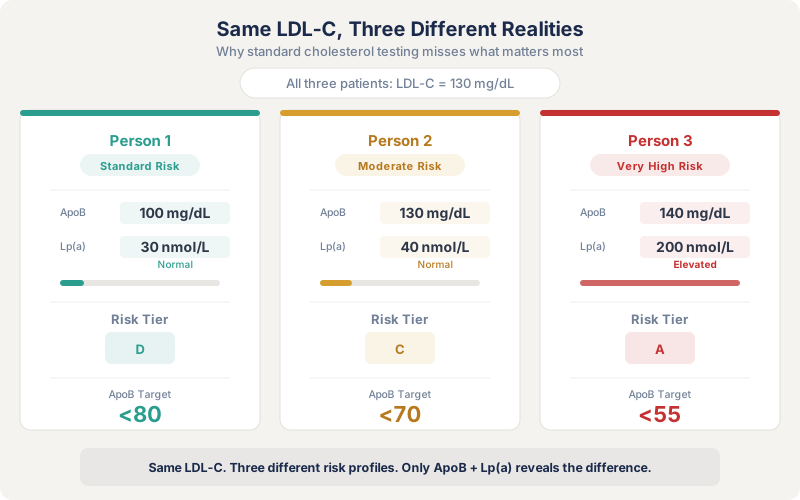
Three people, all with LDL-C of 130, a number most doctors would call borderline or mildly elevated. Same starting point. Very different situations.
Person A: LDL-C 130, ApoB 90, Lp(a) 30. Standard risk. ApoB target of 80, gap of 10. Lifestyle modifications for 12 weeks, then recheck. This person is genuinely close to optimal.
Person B: LDL-C 130, ApoB 140, Lp(a) 40. ApoB is discordantly high, with many more atherogenic particles than the LDL-C suggests. Tier C (ApoB above 100 at baseline). Target of 70, gap of 70. Pharmacotherapy plus lifestyle from day one. This person is not borderline. They have a high particle count that LDL-C masked.
Person C: LDL-C 130, ApoB 120, Lp(a) 180. High ApoB and very high Lp(a). Tier A. Target of 55, gap of 65, and a meaningful fraction of that ApoB comes from Lp(a) particles that won’t respond to standard lipid therapy. Aggressive pharmacotherapy to reduce the modifiable portion as far as possible, because the Lp(a) contribution isn’t going anywhere.
LDL-C told the same story for all three. ApoB and Lp(a) told three completely different stories.
The evidence base
The relationship between ApoB, Lp(a), and cardiovascular disease isn’t speculative.
Mendelian randomization studies use genetic variants as natural experiments to isolate causation from association. Multiple independent analyses have established that ApoB-containing particles are causally linked to atherosclerotic cardiovascular disease. Not correlated: causal.
Elevated Lp(a) independently increases the risk of heart attack, stroke, and aortic valve stenosis. Lp(a) isn’t a direct input to the 2023 AHA PREVENT risk calculator, but it informs risk stratification in ways that standard calculators miss.
The CTT meta-analysis of statin trials confirmed that LDL reduction produces proportional reductions in cardiovascular events, and that this holds equally in men and women. Statins remain first-line for elevated ApoB.
The niacin story is instructive. AIM-HIGH and HPS2-THRIVE both showed that niacin added to statin therapy doesn’t reduce cardiovascular events, despite raising HDL and lowering LDL on paper. Treating surrogate markers instead of causal ones produces interventions that look good on a lab report and do nothing for outcomes.
On Lp(a) treatment: several therapies are in late-stage trials. If approved, they would be the first drugs capable of substantially reducing Lp(a). Nothing exists now. That’s why the current strategy is to drive down the modifiable portion of ApoB as low as possible to compensate for the Lp(a) fraction you can’t touch.
CAC score: breaking treatment-decision ties
For members in Tier C (moderate risk, ApoB target below 70), a coronary artery calcium (CAC) score can break a treatment-decision tie. CAC is a CT scan that measures calcified plaque in the coronary arteries. It tells you how much atherosclerosis has already occurred.
A CAC above zero means plaque exists. For a Tier C member on the fence between lifestyle-first and immediate pharmacotherapy, seeing an actual number changes the calculus.
The part that gets missed: CAC of zero doesn’t mean you’re safe. It means calcified plaque hasn’t formed yet. Soft, non-calcified plaque, the type most likely to rupture, doesn’t show on CAC. A zero score with high ApoB means arterial exposure is ongoing but hasn’t yet produced visible calcification. Absence of evidence is not evidence of absence.
Use CAC as a tiebreaker. Don’t use it as your primary assessment.
Why most doctors don’t test both
The standard lipid panel (total cholesterol, LDL-C, HDL-C, triglycerides) has been default cardiovascular screening for decades. Inexpensive, widely available, embedded in every guideline. ApoB and Lp(a) are better, but medicine doesn’t update on a quarterly cycle.
Most primary care physicians trained on LDL-C. Their EMR templates default to the standard lipid panel. Their guideline flowcharts start with LDL-C thresholds. Ordering ApoB and Lp(a) means stepping outside the default and making a case to the patient for why it matters.
The two measurements that would most improve cardiovascular risk prediction are among the least frequently ordered.
What proactive assessment looks like
The Protocol Cardiovascular Risk protocol tests ApoB at baseline and Lp(a) once. Every member. No exceptions.
Those two numbers, combined with family history, prior events, and CAC where indicated, determine the risk tier, set the ApoB target, and start the treatment protocol. Not in six months. Not at the next annual physical. At the first assessment.
ApoB is rechecked at 6-12 weeks to confirm the protocol is working. Adjustments come from objective measurements, not from assumptions. Someone is actively tracking your progress and adjusting the plan. You’re not just waiting to schedule your own recheck.
Protocol members who complete the Cardiovascular Risk protocol go from 27% ApoB optimal attainment at baseline to 69%. That’s what happens when you measure what matters and act on what you find.
The two numbers worth knowing
ApoB tells you how many atherogenic particles are in your blood: the total burden driving plaque formation.
Lp(a) tells you whether a meaningful fraction of that burden is genetic, permanent, and invisible to standard lipid panels.
Read together, they predict cardiovascular disease risk better than LDL-C, determine the right target, and tell you which interventions will actually move the needle. LDL-C can’t do any of that.
Want to know your ApoB and Lp(a)? Book a Discovery Call to get both measured, your risk tier assigned, and a specific protocol built around your numbers.
Related Content
Cardiovascular Risk→