

 ← Back to Blog
 Cancer screening by risk tier, not by age

Cancer screening by risk tier, not by age
Standard cancer screening guidelines are built around age. Colonoscopy at 45. Mammography at 40. PSA discussion at 55. These cutoffs come from population-level data, and they work reasonably well for people who are, in fact, average risk. Most people aren’t.
A 42-year-old woman with dense breast tissue, a mother diagnosed with breast cancer at 48, and elevated fasting insulin is not the same clinical situation as a 42-year-old with none of those factors. Screening them identically (same tests, same intervals, same start ages) means one is under-screened and the other is getting unnecessary procedures.
Protocol’s Cancer Prevention protocol (Protocol 9) replaces age-based defaults with a three-tier risk stratification system. Your tier determines what you screen for, when you start, and how often you repeat it. The same person can be Tier 1 for one cancer and Tier 3 for another. Risk is cancer-specific, not person-specific.
The three-tier system
Tier 1: average risk
No family history of the specific cancer. No known genetic variants. No modifiable risk factors like obesity, insulin resistance, smoking history, or dense breast tissue.
This is the baseline. Screening follows standard evidence-based guidelines at standard intervals. Screening earlier or more frequently increases false positives without proportionate benefit, which is its own harm.
Tier 2: elevated risk
One first-degree relative (parent, sibling, or child) diagnosed with the specific cancer after age 50. OR one of the following modifiable risk factors: BMI above 30, dense breast tissue (BI-RADS C or D), or documented insulin resistance (fasting insulin above 10 uIU/mL or HOMA-IR above 2.5).
Tier 2 means earlier start dates, shorter intervals, or additional imaging on top of the standard protocol, depending on which cancer and which risk factor applies.
Tier 3: high risk
First-degree relative diagnosed before age 50. OR a known pathogenic genetic variant (BRCA1/2, Lynch syndrome, Li-Fraumeni, others). OR a personal history of the cancer in question. OR multiple first-degree relatives with the same cancer type.
Tier 3 triggers the most aggressive screening schedule: genetic counseling, additional imaging (MRI alongside mammography, for example), and discussion of chemoprevention or prophylactic interventions.
How one person can span multiple tiers
Take a 45-year-old man. His father was diagnosed with colon cancer at 62. He has no family history of prostate, lung, or skin cancer. He has never smoked. His BMI is 27, fasting insulin is 8 uIU/mL, and hsCRP is 0.9 mg/L.
His risk tiers by cancer type:
- Colorectal: Tier 2 (one first-degree relative diagnosed after 50)
- Prostate: Tier 1 (no family history, no risk factors)
- Lung: Tier 1 (never smoker)
- Skin: Tier 1 (no history)
His screening plan reflects those tiers. Colorectal starts earlier and repeats more frequently. Everything else follows standard protocols. Same person, different answers depending on which cancer you’re asking about.
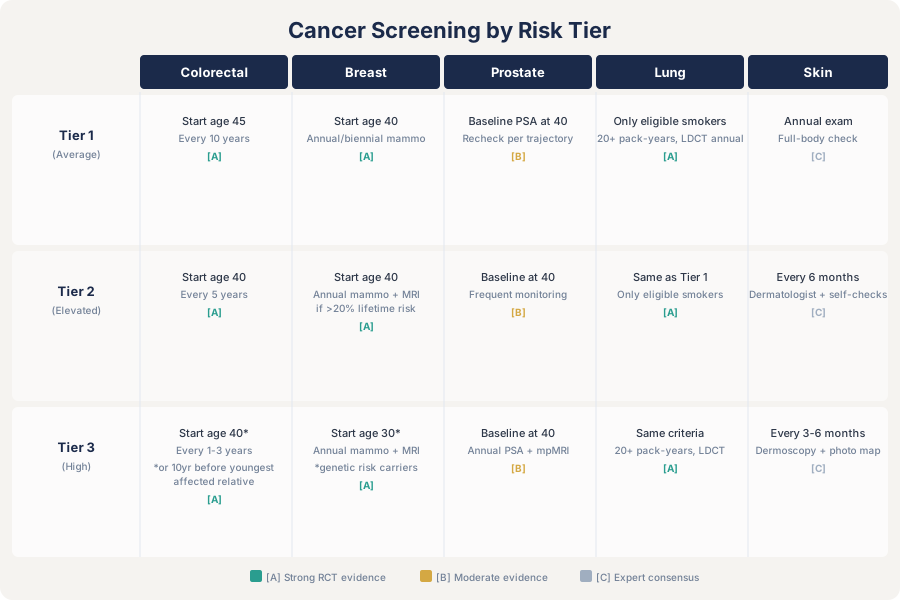
Cancer-by-cancer screening protocols
Colorectal cancer
Evidence grade: [A]. RCT and observational evidence supports colonoscopy for colorectal cancer mortality reduction; the 2022 NordICC trial showed significant benefit in per-protocol (adherent) analysis, with ongoing RCT follow-up.
| Tier | Start Age | Interval | Modality |
|---|---|---|---|
| Tier 1 | 45 | Every 10 years | Colonoscopy |
| Tier 2 | 40 | Every 5 years | Colonoscopy |
| Tier 3 | 40 or 10 years before youngest affected relative (whichever is earlier) | Every 1-3 years | Colonoscopy |
Colonoscopy is both diagnostic and therapeutic: polyps are removed during the procedure, interrupting the adenoma-to-carcinoma sequence before a cancer forms. Stool-based tests (FIT, Cologuard) are options for Tier 1 individuals who decline colonoscopy, but FIT requires annual testing and Cologuard every 1-3 years, and any positive result still requires colonoscopy for follow-up.
Both USPSTF and ACS set the average-risk start at 45, with USPSTF recommending through age 75.
Breast cancer
Evidence grade: [A]. Multiple RCTs demonstrate that mammography reduces breast cancer mortality. USPSTF (2024) recommends biennial screening starting at age 40.
| Tier | Start Age | Interval | Modality |
|---|---|---|---|
| Tier 1 | 40 | Annual or biennial mammography | Mammography |
| Tier 2 | 40 | Annual mammography + consider supplemental MRI | Mammography + breast MRI if Tyrer-Cuzick lifetime risk >20% |
| Tier 3 | 30 (or 10 years before youngest affected relative) | Annual mammography + annual breast MRI | Mammography + MRI |
The Tyrer-Cuzick model (IBIS tool) calculates lifetime breast cancer risk using family history, reproductive history, breast density, and other factors. A lifetime risk above 20% qualifies for supplemental MRI screening, a threshold endorsed by ACS and the American College of Radiology.
Dense breast tissue (BI-RADS C or D) is both a risk factor for breast cancer and a masking factor that reduces mammographic sensitivity. Mammography misses roughly 40-50% of cancers in women with extremely dense breasts. Women with dense breasts should discuss supplemental screening (MRI or contrast-enhanced mammography) with their care team regardless of Tyrer-Cuzick score or family history.
Prostate cancer
Evidence grade: [B] for PSA-based screening. RCT evidence is conflicting (ERSPC showed benefit, PLCO did not); USPSTF recommends shared decision-making for men 55-69.
Protocol’s approach differs from routine PSA screening. A baseline PSA at age 40 is used for risk stratification, not as a screening test in the traditional sense.
| Tier | Approach |
|---|---|
| Tier 1 | Baseline PSA at 40. If PSA <1.0 ng/mL, recheck at 45 and 50. If PSA 1.0-2.5, recheck every 2 years. If PSA >2.5, urology referral. |
| Tier 2 | Baseline PSA at 40. More frequent monitoring based on trajectory. Consider 4Kscore or SelectMDx if PSA rises. |
| Tier 3 | Baseline PSA at 40. Annual monitoring. Multiparametric MRI for any concerning PSA trajectory. Genetic counseling if BRCA2 carrier. |
A single PSA value is less informative than PSA velocity, the rate of change over time. A man with a PSA of 1.2 at age 40 and 1.3 at age 45 has a very different risk profile than a man with PSA of 1.2 at 40 and 2.4 at 45. Baseline measurement at 40 makes all subsequent values interpretable.
Lung cancer
Evidence grade: [A]. The National Lung Screening Trial (NLST) demonstrated that low-dose CT (LDCT) reduces lung cancer mortality by 20% in high-risk smokers.
| Eligibility | Modality | Interval |
|---|---|---|
| Age 50-80, 20+ pack-year smoking history, currently smoking or quit within 15 years | Low-dose CT | Annual |
USPSTF expanded eligibility in 2021 from 30 to 20 pack-years and lowered the start age from 55 to 50. Unlike breast or colorectal cancer screening, eligibility here is essentially binary: you either have the smoking history or you don’t.
For non-smokers, there is no [A]-level evidence supporting routine lung cancer screening. Secondhand smoke exposure, radon, and occupational exposures (asbestos, certain chemicals) warrant physician discussion, but no validated protocol exists for these exposures.
Skin cancer
Evidence grade: [C]. No RCT evidence that routine skin screening reduces melanoma mortality. Expert consensus supports annual dermatologic examination.
| Tier | Approach |
|---|---|
| All tiers | Annual full-body skin exam with a dermatologist |
| Tier 2+ (personal history of atypical nevi, significant sun exposure, immunosuppression) | Every 6 months, with dermoscopic monitoring of atypical lesions |
| Tier 3 (personal or family history of melanoma) | Every 3-6 months, total body photography for comparison |
Skin cancer screening is a clinical exam, not a laboratory or imaging study. The barrier is low (it’s a full-body exam with a dermatoscope), and observational data consistently shows that earlier melanoma detection improves survival, even without an RCT to formalize it.
Evidence grading: why it matters
A recommendation to screen isn’t the same as strong evidence that screening saves lives. The grading system here distinguishes between the two.
[A]: Strong evidence for mortality reduction. RCT or high-quality observational evidence supports that this screening test, applied to the appropriate population, reduces deaths from the cancer in question. Colonoscopy, mammography, and LDCT for lung cancer meet this standard.
[B]: Mixed or contested evidence. RCT evidence exists but with significant methodological limitations, conflicting results across trials, or net benefit that remains debated in the literature. PSA-based prostate cancer screening falls here. ERSPC showed mortality benefit while PLCO did not, leading to ongoing expert disagreement.
[C]: Expert inference. The screening test is biologically plausible and endorsed by expert organizations, but lacks direct evidence of mortality reduction. Skin cancer screening and multi-cancer early detection tests (Galleri, whole-body MRI) are in this category.
When you build a screening plan, [A]-level tests are non-negotiable for your tier. [B]-level tests warrant discussion and shared decision-making. [C]-level tests are optional additions that may fit specific risk profiles but should never displace [A]-level screening.
Risk tiers are reassessed annually
Risk tiers aren’t fixed. A new family diagnosis can move someone from Tier 1 to Tier 2 overnight. So can weight gain past BMI 30, a new insulin resistance finding, or a breast density reclassification.
Protocol reassesses tiers annually. Each year’s review pulls in updated family history, current biomarkers, and any new clinical findings, the same data already generated by other protocols in the program.
Cancer screening isn’t a one-time decision you made at 45 and filed away. It’s a protocol that should change as your risk profile changes.
What this means for you
If your screening plan is based on age alone, you may be missing tests you need or getting ones you don’t. A 38-year-old whose parent was diagnosed with colon cancer at 47 should already be getting colonoscopies. Waiting until 45 because that’s the guideline cutoff isn’t cautious; it’s a gap.
The risk-tiered approach takes more work upfront: a detailed three-generation family history, genetic risk assessment when warranted, and biomarker data from metabolic and inflammatory workups. That’s a higher bar than checking a box on an intake form. But it’s the difference between a screening plan built around your actual risk and one built around a population you may have nothing in common with.
Want a screening plan built around your specific risk profile? Book a Discovery Call to learn how Protocol’s Cancer Prevention protocol matches screening intensity to your risk tier, not just your birthday.
Related Content
Cancer Prevention→