

 ← Back to Blog
 Should you get a galleri test? what the evidence actually shows
Should you get a galleri test? what the evidence actually shows
The Galleri test, a liquid biopsy that screens for over 50 cancer types from a single blood draw, has attracted significant interest in proactive health circles. At $949 per test with no insurance coverage, it’s a substantial upfront cost before you’ve evaluated whether it delivers meaningful benefit. So what does the evidence actually show?
At Protocol, we grade every screening recommendation against published data. Galleri earns an evidence grade of [C], meaning expert inference only, with no randomized controlled trial (RCT) evidence that it reduces cancer deaths. That doesn’t make it useless. It means you need to understand exactly what it can and can’t do before writing the check.
How the galleri test works
Galleri detects cell-free DNA, fragments of genetic material that tumors shed into the bloodstream. By analyzing methylation patterns on that DNA, the test identifies signals associated with specific cancer types. The goal: catch cancer early through a routine blood draw, before symptoms appear.
The promise is real. Multi-cancer early detection (MCED) is a legitimate field of research with major investment from GRAIL (the company behind Galleri), academic medical centers, and the UK’s National Health Service.
But promise and proof are different things.
The sensitivity problem: stage matters
Sensitivity (the test’s ability to correctly identify someone who has cancer) varies dramatically by stage. Data from the CCGA (Circulating Cell-free Genome Atlas) study:
- Stage I cancers: 16.8% sensitivity
- Stage II cancers: 40.4% sensitivity
- Stage III cancers: 77% sensitivity
- Stage IV cancers: 90.1% sensitivity
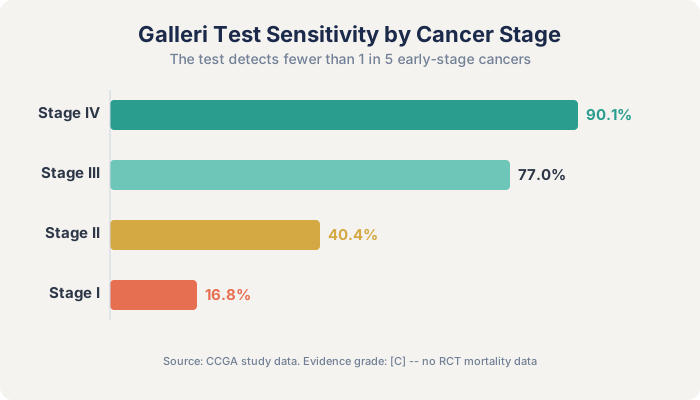
Read those numbers carefully. For stage I cancers, the ones you most want to catch early, the test detects fewer than 1 in 5. It performs best at finding cancers that are already advanced, which is the opposite of what most people assume when they hear “early detection.”
The test isn’t broken. The biology is hard. Early-stage tumors shed less cell-free DNA, making detection inherently more difficult. But a negative Galleri result provides limited reassurance about early-stage disease.
False positives: the PATHFINDER study
The PATHFINDER study enrolled approximately 6,600 adults aged 50 and older to evaluate Galleri in a real-world clinical setting. Among those who received a positive result, approximately 60% turned out to be false positives, meaning the test flagged cancer that wasn’t there.
A false positive on a cancer screening test is not a minor inconvenience. It triggers follow-up imaging, biopsies, specialist referrals, and weeks or months of anxiety. For a test that costs $949 out of pocket, a ~60% false positive rate among positives is a number worth sitting with before you order the kit.
The overall specificity (its ability to correctly identify people without cancer) is high, around 99.5%. That sounds reassuring until you do the math. When cancer prevalence in the screened population is low, even a 0.5% false positive rate generates a lot of unnecessary workups at scale.
The NHS-Galleri trial: a cautionary signal
The UK’s National Health Service ran a large-scale randomized trial of Galleri to determine whether it could reduce late-stage cancer diagnoses at a population level.
Results published in 2025 showed that Galleri did not significantly reduce late-stage cancer diagnoses, which was the primary endpoint. The NHS runs some of the most rigorous screening evaluations in the world. When a test fails its primary endpoint in a large, well-designed randomized trial there, it matters.
The technology isn’t dead. But the current version of the test did not meet the bar for population-level screening in a system that demands proof of clinical benefit.
What evidence grade [c] means
Protocol uses a three-tier evidence grading system for all screening recommendations:
- [A]: RCT evidence for mortality reduction. Colonoscopy for colorectal cancer, mammography for breast cancer, and low-dose CT for lung cancer in eligible smokers all meet this bar.
- [B]: Observational evidence supporting benefit. Strong data, but not from randomized trials.
- [C]: Expert inference only. Biologically plausible, mechanistically sound, but no direct evidence that the intervention reduces cancer deaths.
Galleri is [C]. There are no completed RCTs showing that Galleri screening reduces cancer mortality. The sensitivity data is real, the biology is sound, but the question that actually matters (does this test save lives?) remains unanswered.
For context, PSA screening for prostate cancer spent decades at a similar evidence level before large RCTs clarified its benefits and harms. Evidence grades change as data accumulates. [C] today does not mean [C] forever.
What galleri can and can’t do
It can detect cancers that have no current guideline-based screening test, including pancreatic, ovarian, liver, and others. It can identify the tissue of origin with reasonable accuracy, which helps direct the diagnostic workup when a signal comes back positive. For someone at very high risk who wants maximum surveillance, it adds a layer.
What it can’t do is replace guideline-based screening. A positive Galleri doesn’t substitute for colonoscopy, mammography, or low-dose CT. It adds to them. A negative result doesn’t mean you’re cancer-free; with 16.8% sensitivity for stage I, the test misses more than 4 out of 5 early cancers. No RCT has shown that Galleri screening leads to fewer cancer deaths. And if you’re thinking about easing up on risk-factor work because you tested negative, that logic doesn’t hold. The modifiable factors driving roughly 40% of cancers still apply regardless of what a blood test shows.
Protocol’s approach: risk tiers first
Our Cancer Prevention protocol (Protocol 9) starts with a three-tier risk stratification system based on family history, genetic risk factors, and modifiable exposures. That determines which [A]-level screening tests you need, how often, and at what starting age.
For someone in Tier 1 (average risk) with no family history and no notable risk factors, the evidence doesn’t support Galleri as a routine annual screen. The false positive rate, the cost, and the limited early-stage sensitivity make it a poor trade compared to screenings with proven mortality benefit.
For someone in Tier 3 (high risk), such as a first-degree relative diagnosed before 50, a known BRCA1/2 or Lynch syndrome variant, or a personal cancer history, the math shifts. These individuals face elevated baseline risk, and gaps in established screening protocols are real. Pancreatic cancer in BRCA2 carriers or those with familial pancreatic cancer syndromes is one example: there’s no validated surveillance standard, which is exactly where a test like Galleri could add something. For this population, Galleri may be a reasonable supplement to an already aggressive screening program.
Galleri doesn’t replace anything in that plan. It adds a surveillance layer for the cancers that don’t have better options yet.
The cost question
At $949 per test with annual repeat testing recommended by GRAIL, this is a $949/year ongoing expense with no insurance coverage. Over a decade, that’s nearly $10,000, before accounting for follow-up workups triggered by positive or indeterminate results.
A screening colonoscopy every 10 years is typically covered by insurance and has [A]-level RCT evidence for reducing colorectal cancer mortality. Dollar for dollar, that’s a harder trade to argue against.
This isn’t an argument against spending money on health. It’s an argument for sequencing: build the evidence-based foundation first, then layer in tools where the evidence is weaker.
So, should you get one?
Galleri isn’t ready for routine use. The sensitivity numbers are underwhelming for early-stage cancers, the NHS trial didn’t meet its primary endpoint, and no RCT has demonstrated mortality reduction.
It’s not worthless, either. For high-risk individuals with cancers that lack established screening protocols, it fills a genuine gap. For everyone else, it’s a $949 bet on a technology that may prove out in future iterations but currently earns a [C].
Build your screening plan on [A]-level evidence first. Know your risk tier. Get your colonoscopy, your mammogram, your low-dose CT if you’re eligible. Work on the modifiable risk factors (insulin resistance, inflammation, body composition, alcohol, physical activity) that drive roughly 40% of all cancers. If Galleri adds something real to your specific risk profile after all that, it’s worth considering. But it’s the last piece, not the first.
If you want help building a screening plan matched to your actual risk factors, not a one-size-fits-all test, that’s what our Cancer Prevention protocol does.
Ready to build a cancer screening plan based on your actual risk profile? Book a Discovery Call to learn how Protocol’s evidence-graded approach matches screening intensity to your specific risk tier.
Related Content
Cancer Prevention→