

 ← Back to Blog
 What fasting insulin tells you that A1c misses
What fasting insulin tells you that A1c misses
Every year, about 100 million Americans get an annual physical. Most of those physicals include fasting glucose and A1c. Almost none include fasting insulin.
Fasting insulin catches metabolic dysfunction 5-10 years before A1c does. Those are exactly the years where intervention is easiest and most effective, before the compensation breaks down.
If you’ve only ever seen your A1c and fasting glucose (and both looked normal), you might already have insulin resistance and not know it. Here’s how the two tests work, why they tell you different things, and what a fasting insulin test actually reveals.
Two tests, two very different questions
A1c measures your average blood sugar over the past 2-3 months. It answers the question: “Is glucose building up in your blood?”
Fasting insulin measures how much insulin your pancreas is producing first thing in the morning after an overnight fast. It answers a different question: “How hard is your body working to keep blood sugar normal?”
These are not the same question, and the gap between them is where metabolic dysfunction hides for years.
Insulin resistance doesn’t start with high blood sugar. It starts with high insulin. Your cells become less responsive to insulin’s signal, so your pancreas produces more insulin to compensate. For years (sometimes a decade), this compensation works. Blood sugar stays normal. A1c stays normal. Fasting glucose stays normal.
But underneath those normal numbers, your pancreas is overworking. Insulin levels are climbing. And by the time blood sugar finally rises enough to flag an abnormal A1c, metabolic damage has already been accumulating for years.
Fasting insulin catches this during the compensation phase, when blood sugar still looks fine but the machinery keeping it fine is under strain.
The timeline of metabolic dysfunction
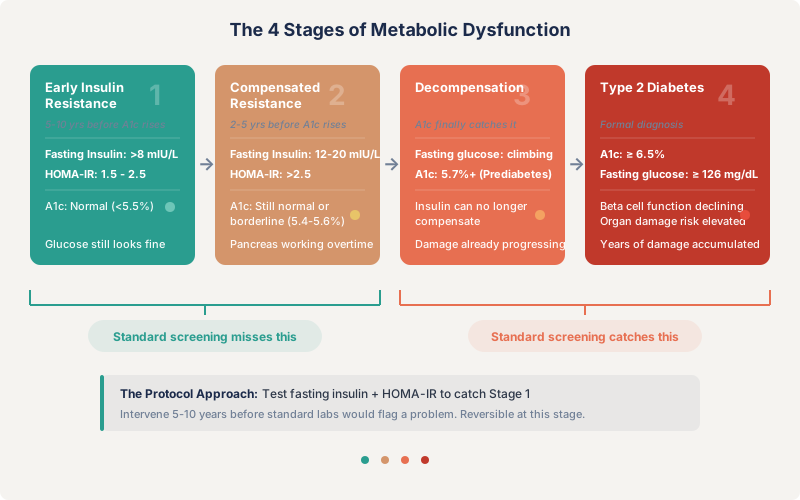
The progression looks like this:
Stage 1: early insulin resistance (5-10 years before A1c elevation) Cells become less sensitive to insulin. Pancreas increases insulin output. Fasting insulin rises above 8 mIU/L. Fasting glucose and A1c: completely normal. No flags on any standard lab panel.
Stage 2: compensated insulin resistance (2-5 years before A1c elevation) Insulin levels continue climbing. Fasting insulin may be 12-20 mIU/L. HOMA-IR (a formula that combines your fasting insulin and glucose to estimate how resistant your cells are to insulin) rises above 2.5. Post-meal blood sugars start running higher, but fasting glucose and A1c may still be in the “normal” range or just barely elevated.
Stage 3: decompensation (A1c finally catches it) The pancreas can no longer produce enough insulin to keep blood sugar controlled. Fasting glucose climbs. A1c crosses 5.7%. Your doctor says “prediabetes” and tells you to come back in six months.
Stage 4: type 2 diabetes A1c crosses 6.5%. Now there’s a formal diagnosis. Medication is discussed.
Standard screening catches you at Stage 3 or 4. A fasting insulin test catches you at Stage 1, when the fix is a few targeted lifestyle changes instead of medication management.
HOMA-IR: turning two numbers into one answer
Fasting insulin by itself is useful. Combined with fasting glucose, it’s more useful. The formula is simple:
HOMA-IR = (fasting insulin x fasting glucose) / 405
One number, one read on how well your cells are responding to insulin:
| HOMA-IR | Assessment | What It Means |
|---|---|---|
| Below 1.0 | Optimal | Excellent insulin sensitivity |
| Below 1.5 | Healthy | Cells responding well to insulin |
| 1.5 - 2.5 | Early dysregulation | Insulin climbing, glucose still controlled (the intervention sweet spot) |
| Above 2.5 | Insulin resistant | Pancreas overworking to maintain glucose |
| Above 4.0 | Significant resistance | High risk of progression to prediabetes/diabetes |
Take someone with a fasting glucose of 92 mg/dL (normal) and a fasting insulin of 14 mIU/L (elevated). Their HOMA-IR is 3.2: solidly insulin resistant. Their annual physical shows completely normal glucose. A1c might be 5.4%. No flags anywhere. But their pancreas is working twice as hard as it should to hold those numbers steady.
Without fasting insulin, this person has no idea they’re in trouble.
What fasting insulin numbers actually mean
There’s no universal “normal range” for fasting insulin because most labs set their reference range based on population averages, which include a population where over 40% have some degree of insulin resistance. A lab might report a fasting insulin of 15 mIU/L as “within normal limits” because it falls within the range of common values. Common isn’t optimal.
A more clinically useful framework:
| Fasting Insulin | Assessment |
|---|---|
| Below 5 mIU/L | Optimal: highly insulin sensitive |
| 5 - 8 mIU/L | Healthy: normal insulin sensitivity |
| 8 - 12 mIU/L | Early dysregulation: insulin rising, glucose still controlled |
| 12 - 20 mIU/L | Elevated: likely insulin resistant even if A1c is normal |
| Above 20 mIU/L | High metabolic risk |
A fasting insulin of 10 with an A1c of 5.3 is a person whose labs look “clean” on a standard panel. But that insulin level, firmly in the early dysregulation range, signals that their cells are already less responsive to insulin. This is the moment when targeted intervention (meal sequencing, post-meal movement, resistance training, sleep optimization) does the most good.
Wait until A1c catches up, and you’re chasing a more advanced problem.
The TG:HDL ratio: a free proxy you already have
If you’ve had a standard lipid panel, you already have another proxy for insulin resistance sitting in your results: your TG:HDL ratio: your triglycerides divided by your HDL cholesterol.
| TG:HDL Ratio | Assessment |
|---|---|
| Below 1.0 | Optimal insulin sensitivity |
| 1.0 - 1.5 | Healthy |
| 1.5 - 2.0 | Possible early insulin resistance |
| Above 2.0 | Likely insulin resistant |
| Above 3.5 | Strongly associated with insulin resistance and metabolic syndrome |
This isn’t as precise as HOMA-IR, but it’s a useful screening signal, especially since you may already have the numbers from a recent cholesterol panel. If your TG:HDL ratio is above 2.0 and you’ve never had fasting insulin tested, it’s worth ordering.
Insulin resistance and cancer risk
Insulin resistance isn’t just a diabetes precursor. Elevated fasting insulin is independently associated with increased risk of several cancers.
Insulin is a growth factor. It promotes cell proliferation. When insulin levels are chronically elevated (as they are in insulin resistance), cells prone to uncontrolled growth get a sustained growth signal.
The associations are strongest for breast cancer (in both pre- and postmenopausal women), colorectal cancer, pancreatic cancer, and endometrial cancer, with endometrial risk elevated independently of obesity, which is notable because obesity is usually the assumed driver.
This doesn’t mean insulin resistance causes these cancers. The relationships are complex, and obesity, inflammation, and other factors are intertwined. But it does mean that addressing insulin resistance (driving fasting insulin down, improving HOMA-IR) may reduce risk across multiple disease categories, not just metabolic ones.
And it’s another reason why waiting until A1c flags a problem is the wrong approach. If insulin has been elevated for a decade before A1c catches it, that’s a decade of elevated growth signaling to every cell in your body.
Why most annual physicals miss this
Standard lab panels are built around population-level screening thresholds that prioritize specificity (avoiding false positives) over sensitivity. They’re designed to confirm disease, not detect the decade of dysfunction that leads to it. A1c and fasting glucose are good at one job. Early detection isn’t it.
Fasting insulin costs about $25 at most labs. It requires no special preparation beyond the same overnight fast you already do for glucose testing. And yet it’s not part of standard screening.
This is the gap between reactive medicine (“your A1c is 6.1, let’s start metformin”) and proactive assessment (“your fasting insulin is 13 with a normal A1c, let’s intervene now while the fix is lifestyle changes, not medication”).
What to do with this information
If you’ve never had fasting insulin tested:
Order it. Either ask your doctor to add it to your next blood draw or use a direct-to-consumer lab (Quest, Labcorp, and several online services offer it for $25-40 without a doctor’s order in most states).
Get fasting insulin and fasting glucose from the same blood draw. Calculate your HOMA-IR. Check your TG:HDL ratio from your most recent lipid panel.
If your fasting insulin is below 8 and HOMA-IR is below 1.5:
You’re metabolically healthy by these markers. Retest annually. Keep doing what you’re doing.
If your fasting insulin is 8-12 or HOMA-IR is 1.5-2.5:
You’re in the early dysregulation range: the best window for intervention, when small changes still move the numbers. What actually works at this stage:
- Post-meal walks (15 minutes after your largest meal)
- Protein-first meal sequencing (eat protein and fiber before starches)
- Sleep optimization (7+ hours; sustained sleep restriction has been shown to impair insulin sensitivity meaningfully in controlled studies)
- Resistance training (2-3 sessions per week)
- 14-day CGM wear to identify your specific glucose triggers
These interventions can move HOMA-IR meaningfully in the right direction within 60-90 days for most people, enough to see whether you’re responding before the next annual lab draw. Retest at 60 days to confirm the numbers are moving. More detail on the specific approach: Prediabetes is reversible: here’s exactly how.
If your fasting insulin is above 12 or HOMA-IR is above 2.5:
You have established insulin resistance. The same interventions apply, but more aggressively and with closer monitoring. This is where a structured, coached approach (with specific targets, defined retesting intervals, and professional interpretation) makes the difference between slow improvement and spinning your wheels.
If your A1c has already crossed into prediabetic territory (5.7+), read Your A1c is 5.8: now what? for the immediate action plan.
The argument for proactive testing
If you get annual labs, you’re already doing the blood draw. Adding fasting insulin is one extra tube and about $25. What you get back is a window into metabolic function that A1c simply can’t see.
The standard approach (wait for A1c to flag a problem, then react) made sense when there were no good early markers and no proven early interventions. Both of those things are now false. The markers exist. The interventions work. The only question is whether you run the test.
How Protocol uses these markers
At Protocol, fasting insulin and HOMA-IR are part of every member’s baseline assessment. They’re the foundation of our Metabolic Health protocol, not something we add if someone asks.
When we see a member with a fasting insulin of 11, a HOMA-IR of 2.3, and a “normal” A1c of 5.4, we don’t say “looks fine, see you next year.” We say: your body is working harder than it should to maintain those normal glucose numbers, here’s how we measure it, and here are the specific interventions and targets to bring insulin sensitivity back into the healthy range.
Screening asks whether you have a disease. Assessment asks how well the system is actually working. Those are different questions with different answers, and for most people, only one of them is worth asking before something goes wrong.
Want to know what your fasting insulin and HOMA-IR actually are, and what they mean for your metabolic health?
Book a Discovery Call to get a full metabolic baseline with the markers most annual physicals miss.
Related Content
Metabolic Health→