

 ← Back to Blog
 Prediabetes is reversible: here's exactly how
Prediabetes is reversible: here’s exactly how
If you’ve been told you have prediabetes, you’ve probably heard some version of the same advice: lose weight, eat less sugar, exercise more. Maybe your doctor mentioned medication. Maybe they said to come back in six months.
None of that is a plan. It’s a list of vague suggestions with no measurements, no targets, and no way to know if what you’re doing is working.
What the research shows: prediabetes is reversible. Not with willpower or vague dietary advice. With specific, measurable interventions targeted at the underlying problem. You need to know which markers to track, which experiments to run on yourself, and which changes produce the biggest metabolic shifts in the shortest time.
Start with the right marker: HOMA-IR, not A1c
Most people learn about prediabetes through A1c, a blood test that measures your average blood sugar over the past 2-3 months. An A1c between 5.7% and 6.4% puts you in the prediabetic range.
But A1c is a late marker. It catches metabolic dysfunction after your pancreas has been overproducing insulin for years and is finally losing the battle. By the time A1c is elevated, you’ve already passed through the earlier, more treatable stage.
The earlier marker: HOMA-IR, a formula that combines your fasting insulin and glucose to estimate how resistant your cells are to insulin. It’s calculated as (fasting insulin x fasting glucose) / 405.
HOMA-IR catches what A1c misses:
| HOMA-IR | What It Means | A1c at This Stage |
|---|---|---|
| Below 1.5 | Metabolically healthy | Usually normal (< 5.5%) |
| 1.5 - 2.5 | Early dysregulation: insulin rising, glucose still controlled | Often still normal (< 5.7%) |
| Above 2.5 | Insulin resistant: pancreas straining to compensate | May or may not be elevated |
If you already have a prediabetes diagnosis, your HOMA-IR is probably above 2.5. But the number itself matters. Someone at 2.8 has a different intervention timeline than someone at 4.5.
This is your starting line. Get fasting insulin tested (most annual physicals skip this; here’s why that matters) and calculate your HOMA-IR. This is the number you’re going to move.
Why generic dietary advice fails
“Eat fewer carbs” is not wrong, exactly. It’s just too vague to be useful. Which carbs? How much fewer? Does it matter when you eat them or what you eat them with?
The answer to all three: yes. And the specifics vary from person to person more than most people expect.
A white potato spikes one person’s blood sugar to 180 mg/dL and barely moves another past 130. A bowl of oatmeal (supposedly a “healthy” breakfast) sends some people on a glucose roller coaster that lasts four hours. Meanwhile, the same person might handle white rice with steak and vegetables just fine.
This isn’t about good foods and bad foods. It’s about your specific glucose response, which you can only see with data.
The 14-day CGM experiment
A CGM (continuous glucose monitor) is a sensor worn on the back of your arm that measures your blood sugar every few minutes. For 14 days, it shows you exactly what your blood sugar does in response to every meal, every workout, every night of sleep, and every stressful afternoon.
For someone with prediabetes, a CGM does something no food diary or weekly weigh-in can: it shows you what’s actually happening in real time. Not what you think is happening. What is happening.
Three experiments worth running first:
Experiment 1: the walk test
Eat the same meal on two consecutive days. Same food, same portion, same time.
- Day 1: Sit at your desk after eating.
- Day 2: Take a 15-minute walk immediately after eating.
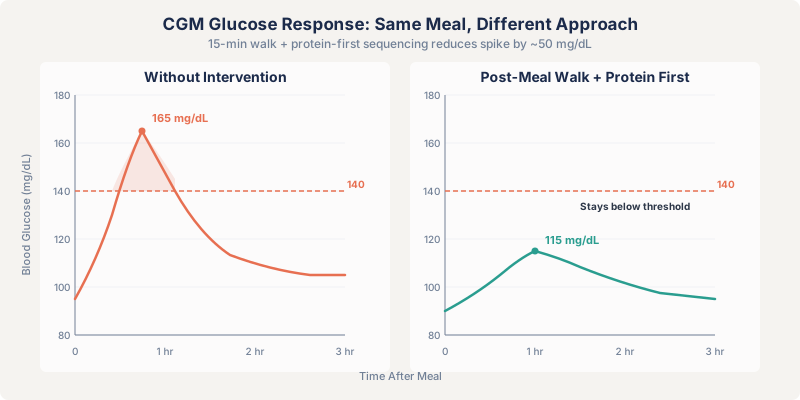
Compare the glucose curves on your CGM. Most people see a 20-30 mg/dL reduction in their post-meal spike on the walking day. Some see even more.
This is not a workout recommendation. It’s a proof-of-concept you can run in 48 hours. When you see your own glucose curve flatten by 25 mg/dL from a 15-minute walk, the post-meal walk stops being advice someone gave you and becomes something you’ve proven works for your body.
Experiment 2: the protein anchor
Eat a meal in two different orders on two different days:
- Day 1: Start with the carbohydrate portion (bread, rice, potatoes), then eat the protein and vegetables.
- Day 2: Start with protein and vegetables, wait 10 minutes, then eat the carbohydrate portion.
Same total calories. Same total macronutrients. The order changes the glucose response dramatically. Eating protein first slows gastric emptying, which slows glucose absorption. A typical result: a 140 mg/dL spike becomes a 110-115 mg/dL rise. Same meal, different sequence, measurably different outcome.
This scales: you do it at every meal without changing what you eat.
Experiment 3: the sleep effect
Track your fasting morning glucose on your CGM for a full week. Compare mornings after 7+ hours of sleep versus mornings after less than 6 hours.
The difference is often 10-15 mg/dL. A night of poor sleep can raise your fasting glucose from a healthy 90 to a borderline 105, not because you ate anything, but because sleep deprivation directly impairs insulin sensitivity.
One night of restricted sleep (4-5 hours) has been shown to reduce insulin sensitivity by 25-30%. Not a long-term trend. An acute, measurable metabolic effect from a single bad night.
If your fasting glucose is consistently elevated and you’re sleeping less than 7 hours, sleep is a metabolic intervention. Possibly the most underrated one.
The prediabetes reversal protocol
Once your labs and CGM data are in, here is the sequence that moves the markers:
Tier 1: the non-negotiables (week 1-2)
Start here. These three changes have the strongest research backing and the lowest friction. You can implement them this week without overhauling anything.
Post-meal walks. 15 minutes after your largest meal, every day. Not optional. Low barrier, consistent effect across nearly every person who tries it. If you only change one thing, change this.
Protein-first meal sequencing. Start every meal with protein and fiber before touching starches or sugars. No calorie counting, no food elimination, no willpower tax. It’s a structural change that works by slowing gastric emptying before carbohydrates arrive.
Sleep floor: 7 hours. Treat this as a metabolic prescription, not a lifestyle preference. If you’re currently getting 5-6 hours, getting to 7 will measurably improve your fasting insulin within weeks.
Tier 2: targeted adjustments (week 3-6)
Once you have two weeks of CGM data, you know which specific foods and meals spike your glucose the most. Now you target those:
Identify your top 3 glucose offenders. Your CGM will make these obvious. Maybe it’s your morning oatmeal, your lunchtime sandwich bread, or your evening pasta. You don’t need to eliminate these. You need to modify them (add protein, change sequence, reduce portion, or replace with a lower-spike alternative).
Add resistance training. Two to three sessions per week. Muscle is the body’s largest glucose disposal organ. Strength training improves insulin sensitivity through a mechanism independent of weight loss. It drives GLUT4 glucose transporters to the surface of muscle cells, where they pull glucose out of your bloodstream. Chronic training also increases total GLUT4 expression over time. You can see this on a CGM: glucose responses to the same meal typically improve on training days.
Morning glucose anchor. If your CGM shows a dawn phenomenon (glucose rising between 4-7 AM before you eat anything), a tablespoon of apple cider vinegar in water before bed, or a small protein-rich snack before sleep, can blunt this for some people. Test it. If it doesn’t move the number, stop.
Tier 3: sustained optimization (month 2-3)
Retest labs at 60 days. Fasting insulin, fasting glucose, HOMA-IR, TG:HDL ratio. This is your progress check. You’re looking for:
- HOMA-IR moving toward 1.5 (from wherever you started)
- Fasting insulin below 10 µIU/mL, ideally trending toward 8
- TG:HDL ratio below 1.5 (an optimal functional target; standard clinical cutoff is 2.0)
- CGM mean glucose below 105 mg/dL
- Time above 140 mg/dL below 10% of readings
You either hit them or you adjust the plan.
Second CGM wear. Repeat the 14-day CGM after implementing your changes. Compare your glucose curves side by side with your first wear. This comparison is where it clicks. You see exactly how much your interventions moved each marker, meal by meal, day by day.
What the research shows about reversal
The Diabetes Prevention Program (a trial with over 3,000 participants) found that structured lifestyle intervention reduced the risk of progressing from prediabetes to type 2 diabetes by 58%. That was more effective than metformin (which reduced risk by 31%).
The interventions in that study were not exotic. They were specific: targeted dietary changes, 150 minutes of moderate activity per week, and 7% body weight loss for those who were overweight. What worked was structure and measurement, not just “eat better and move more.”
Follow-up research since the DPP has reached similar conclusions: when people with prediabetes make targeted changes and track specific metabolic markers, many return to normal glucose regulation. The earlier the intervention (the lower the HOMA-IR at the time of intervention), the higher the success rate.
This is why measuring HOMA-IR matters. An A1c of 5.8 with a HOMA-IR of 2.0 is a very different situation than an A1c of 5.8 with a HOMA-IR of 4.5. The first person is early in the process with a wide intervention window. The second person’s pancreas has been overworking for much longer and may need more aggressive intervention.
What a coached approach looks like
There’s a difference between knowing this list and having someone who can read your specific data, tell you which part of the list actually applies to you, and adjust the plan when the numbers don’t move the way they should.
At Protocol, reversing prediabetes is a structured process within our Metabolic Health protocol:
- Full metabolic baseline. Fasting insulin, HOMA-IR, A1c, TG:HDL ratio, fasting glucose, not just the two markers from your annual physical.
- 14-day CGM wear with coached experiments: the walk test, protein anchor, sleep tracking, and food-specific testing.
- Targeted intervention plan based on your specific data, not a generic prediabetes protocol.
- Defined retesting intervals with specific targets for each marker.
- Coached adjustments based on what the data shows at each checkpoint.
The goal is reversal: driving your HOMA-IR below 1.5, your fasting insulin below 8, and your A1c below 5.5 using interventions matched to your specific metabolic profile.
The window is open, but it closes
Prediabetes is the body’s early warning. Metabolic machinery strained, not broken. The interventions that work (meal sequencing, post-meal movement, sleep, resistance training, targeted dietary changes) are most effective right now, while the dysfunction is still early enough to reverse cleanly.
Every month of inaction narrows the window. Not dramatically; this isn’t an emergency. But the math is real: higher HOMA-IR means longer recovery, harder interventions, and a greater chance of needing medication to bridge the gap.
You don’t need a radical life change. You need the right measurements, a few specific experiments, and a plan with clear targets.
If your A1c just came back elevated, start here: understand what that number means, get the labs your doctor probably didn’t order, and find out where you actually stand.
Want a full metabolic baseline with targets that actually match your numbers?
Book a Discovery Call to start with a coached plan built around your data.
Related Content
Metabolic Health→