

 ← Back to Blog
 Testosterone in women: the conversation your doctor isn't having
Testosterone in women: the conversation your doctor isn’t having
When women think about testosterone, they think about men: muscle, deep voices, aggression. When doctors think about testosterone in women, they often don’t think about it at all. It’s not part of the standard workup. It almost never comes up during conversations about perimenopause or menopause. And when women raise it themselves, they’re frequently met with dismissal or confusion.
But women produce testosterone. Not in the same quantities as men, but in amounts that matter. Testosterone contributes to libido, energy, motivation, muscle maintenance, bone density, and cognitive function in women. Levels decline with age. By menopause, a woman’s testosterone is roughly half what it was at 20.
Low testosterone in women is real, measurable, and treatable. The reason your doctor isn’t bringing it up has more to do with the medical system than with the science.
Why doctors don’t test for it
Three factors keep female testosterone in a clinical blind spot.
There is no FDA-approved testosterone product for women in the United States. Every testosterone prescription for a woman in the US is off-label, using formulations designed for men, at lower doses. That doesn’t mean it’s unsafe or unproven. It means pharmaceutical companies haven’t invested in the approval process for a female-specific product, so there’s no marketing, no drug rep education, and no checkbox in the electronic health record prompting doctors to consider it.
Medical training barely covers the topic. Most physicians receive minimal education on androgen deficiency in women. Training focuses on estrogen and progesterone for women’s health. Testosterone gets treated as a male hormone that occasionally causes problems in women (acne, hair growth) rather than a hormone women need and can become deficient in.
Historical bias toward psychological explanations. Low libido, fatigue, and loss of motivation in women have been attributed to depression, stress, relationship issues, or “just getting older” for decades. These symptoms are real, and they do have psychological components, but they also have a measurable hormonal component that should be assessed before or alongside other explanations.
The result: millions of women with symptoms of androgen deficiency who never get tested, never get diagnosed, and never get treated.
What low testosterone looks like in women
The symptoms overlap with perimenopause, depression, thyroid dysfunction, and chronic fatigue, which is part of why it gets missed. But the pattern is recognizable:
- Low libido that persists even when relationship factors, mood, and estrogen levels are addressed. This is the most well-studied symptom of female androgen deficiency. Not “slightly less interested.” A complete absence of sexual desire that doesn’t match how the woman felt earlier in her life.
- Persistent fatigue that doesn’t improve with adequate sleep. Not the tiredness of a busy life. A deep, physical depletion that makes routine tasks feel effortful.
- Loss of motivation and drive. Women often describe this as losing their “spark” or feeling flat. Goals that used to energize them feel irrelevant. Initiative drops. This gets misdiagnosed as depression, but antidepressants don’t usually resolve it.
- Loss of muscle mass and strength despite consistent exercise. Testosterone is anabolic. It builds and maintains muscle tissue. When it’s deficient, the same workouts produce diminishing returns.
- Cognitive changes: difficulty concentrating, word-finding problems, feeling mentally slow. These overlap with perimenopause broadly, but can be androgen-specific.
The distinguishing factor: these symptoms persist despite adequate estrogen replacement. A woman on appropriate HRT who still has these complaints deserves a testosterone assessment, not a higher estrogen dose or another SSRI.
How to actually measure female testosterone
Testing testosterone in women is more complicated than in men because the levels are much lower and standard assays aren’t always sensitive enough to measure them accurately.
Free testosterone: the number that matters
Total testosterone tells you how much is in your blood. Free testosterone tells you how much is actually available to your tissues. In women, most testosterone is bound to SHBG (sex hormone-binding globulin) or to albumin. The SHBG-bound fraction is tightly held and unavailable; the albumin-bound fraction is loosely held and partially accessible. Only the free (unbound) fraction plus the albumin-bound portion constitute what clinicians call “bioavailable testosterone.” Of those, the free fraction matters most.
SHBG is the variable that changes everything. High SHBG (which increases with age, oral estrogen use, thyroid disease, and low body weight) means more testosterone is bound and unavailable. A woman can have a “normal” total testosterone and still be functionally deficient because SHBG is soaking it all up.
Free testosterone should be calculated using the Vermeulen equation (which uses total testosterone, SHBG, and albumin) or measured directly via equilibrium dialysis. Standard immunoassays for free testosterone are unreliable at the low levels seen in women. The results aren’t precise enough to guide clinical decisions. If your doctor ordered a free testosterone but used a standard immunoassay, the number may not be meaningful.
DHEA-S: the upstream marker
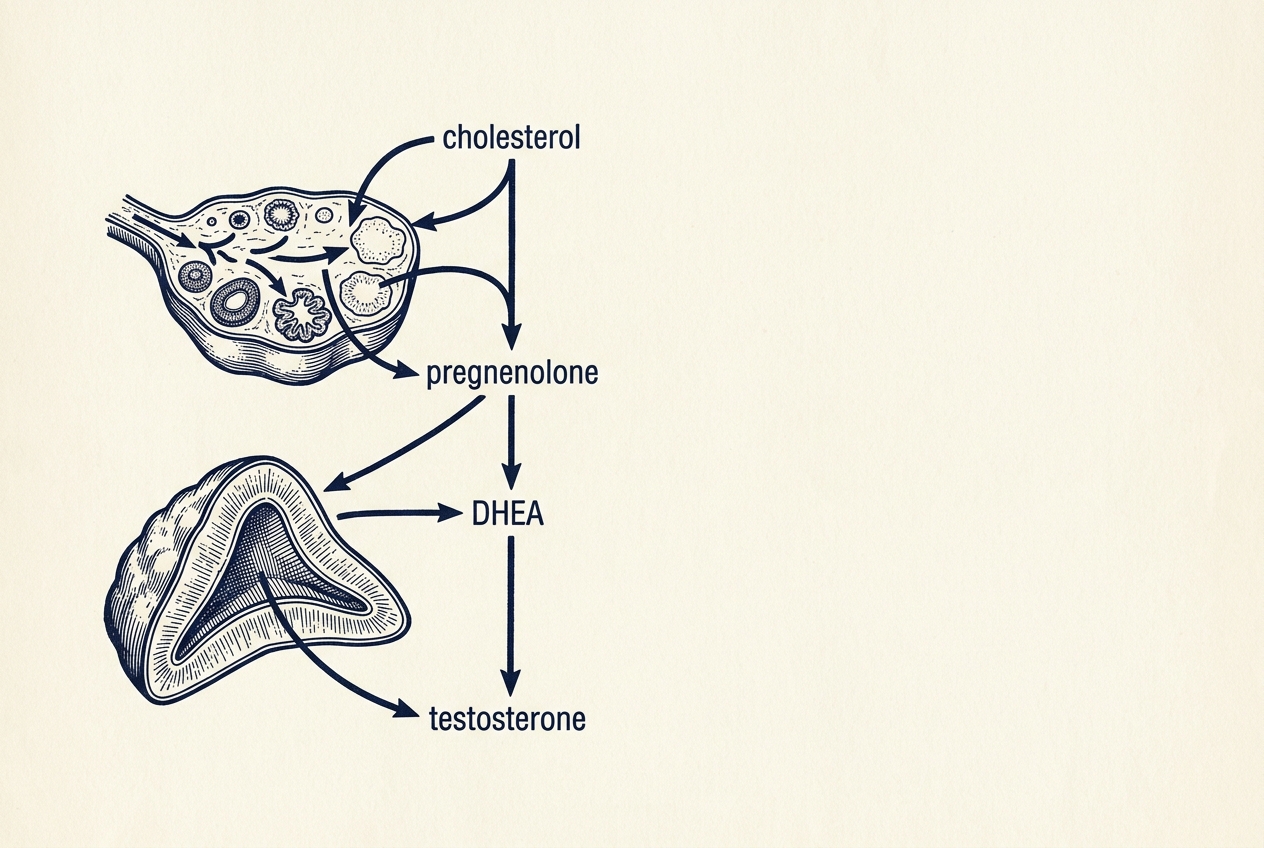
DHEA-S (dehydroepiandrosterone sulfate) is an adrenal androgen and a precursor to testosterone. It’s produced by the adrenal glands and declines steadily with age. Low DHEA-S can contribute to low testosterone, and measuring it helps identify whether the issue is ovarian, adrenal, or both.
Unlike most sex hormones, DHEA-S doesn’t swing much during the day or across the menstrual cycle, which makes it one of the more reliable single-draw markers in the androgen picture.
The full androgen panel
Protocol’s Hormonal Health protocol includes a complete androgen assessment for women with suspected deficiency:
- Total testosterone
- SHBG (to calculate free testosterone via Vermeulen equation)
- DHEA-S
- Albumin (for accurate free testosterone calculation)
This panel, interpreted alongside estradiol, progesterone, and thyroid markers from the broader perimenopause assessment, gives the full hormonal picture.
Treatment: what evidence-based testosterone therapy looks like
Testosterone therapy in women is not the same conversation as TRT in men. Different doses, different delivery methods, different indications, different monitoring. Conflating the two leads to both underdosing (out of excessive caution) and inappropriate prescribing (applying male protocols to female physiology).
Who qualifies
Protocol’s criteria for testosterone therapy in women:
- Documented low free testosterone: calculated via Vermeulen equation or measured by equilibrium dialysis, not just a standard immunoassay
- Symptoms consistent with androgen deficiency: low libido, fatigue, and/or loss of motivation
- Symptoms persist despite adequate estrogen replacement: testosterone isn’t a substitute for getting estrogen right first
- Lifestyle prerequisites addressed: the same 6 prerequisites that apply to estrogen therapy apply here
The third criterion is the one most commonly skipped in practice. Starting testosterone before estrogen is optimized often leads to disappointing results, because many symptoms attributed to androgen deficiency are actually estrogen-related.
Low-dose transdermal only
The delivery method matters. Protocol uses low-dose transdermal testosterone only, applied to the skin via compounded cream or gel. This avoids the first-pass liver metabolism associated with oral testosterone (which isn’t used in women) and provides stable, physiologic levels that can be precisely titrated.
The target is restoring testosterone to a level consistent with a premenopausal woman, not supraphysiologic, not pushed toward male ranges. The goal is replacement, not enhancement.
Monitoring
Women on testosterone therapy need regular monitoring:
- Free testosterone levels rechecked 4 to 6 weeks after starting, then every 3 to 6 months
- Symptom check: are the target symptoms actually improving?
- Side effect screening: acne, oily skin, and unwanted hair growth are dose-dependent. At appropriate doses, these are uncommon. When they appear, the dose is too high.
- Lipid panel: testosterone can affect cholesterol at high doses; at physiologic female doses this is rarely clinically significant
If symptoms don’t improve after 3 to 6 months at adequate levels, testosterone therapy is discontinued. Not every woman with low testosterone will respond to replacement, and continuing ineffective treatment isn’t the answer.
The SHBG factor: why “normal” levels can still be a problem
SHBG deserves its own section because it’s the most common reason testosterone deficiency gets missed in women.
A woman with a total testosterone of 30 ng/dL and an SHBG of 40 nmol/L has meaningfully more bioavailable testosterone than a woman with the same total testosterone and an SHBG of 120 nmol/L. The second woman has most of her testosterone bound and unavailable. She’s functionally deficient despite a “normal” total testosterone.
SHBG goes up with age, oral estrogen use (one of the strongest elevators, another reason Protocol uses transdermal estrogen first-line), overactive thyroid, low body weight, and liver disease (SHBG is produced there). It goes down with obesity, insulin resistance, hypothyroidism, and certain medications.
The same total testosterone reading means something completely different depending on which end of that spectrum you’re on. Without SHBG, you’re reading total testosterone in the dark.
This isn’t fringe medicine
Testosterone therapy for women is supported by the International Menopause Society, the 2019 Global Consensus Position Statement, and multiple international bodies. The Endocrine Society is more cautious. Their 2019 guideline recommends testosterone only for postmenopausal women with hypoactive sexual desire disorder (HSDD), and recommends against its use for other indications. The evidence base for HSDD specifically is strong: multiple randomized controlled trials show efficacy with an acceptable safety profile at physiologic doses.
What’s missing isn’t evidence. It’s implementation. The gap between what the research supports and what happens in a typical doctor’s office is wide. Most women with androgen deficiency never get tested. Those who do often get inaccurate assays. Those who get accurate testing often can’t find a provider willing to prescribe.
That gap is what Protocol is built to close, not with unproven treatments or aggressive protocols, but with the kind of medicine that requires more than a 15-minute appointment to get right.
The female HRT decision tree
Protocol’s Hormonal Health protocol addresses estrogen, progesterone, and testosterone as distinct but connected decisions:
- Assess symptoms and test the full panel: including androgens, not just estrogen and progesterone
- Address lifestyle prerequisites: the 6 factors that affect all hormone therapy outcomes
- Optimize estrogen and progesterone first: the foundation of female HRT
- Reassess androgen symptoms: do they persist despite adequate estrogen?
- Test free testosterone accurately: Vermeulen calculation or equilibrium dialysis
- Initiate low-dose transdermal testosterone if indicated: with specific criteria met
- Monitor and adjust: regular labs, symptom tracking, side effect screening
Testosterone isn’t step one. It’s not an afterthought either. It has a specific place in the sequence, and skipping it leaves a meaningful number of women undertreated.
What to do next
If you’re experiencing persistent fatigue, low libido, or loss of motivation (especially if you’re already on estrogen therapy and these symptoms haven’t resolved), testosterone deserves to be part of the conversation.
Not a casual mention at the end of an appointment. A proper assessment: accurate testing, clinical correlation, and treatment if the evidence supports it.
Protocol’s Hormonal Health protocol includes the full androgen assessment as part of the standard evaluation for women in perimenopause and menopause. Hormones don’t exist in isolation, and neither should the clinical approach to treating them.
Book a Discovery Call to discuss testosterone testing and whether an androgen assessment should be part of your hormonal evaluation.
Related Content
Hormonal Health→