

 ← Back to Blog
 Why your doctor has 2,500 patients and what that means for you
Why your doctor has 2,500 patients and what that means for you
Your doctor isn’t bad at their job. They’re doing an impossible one.
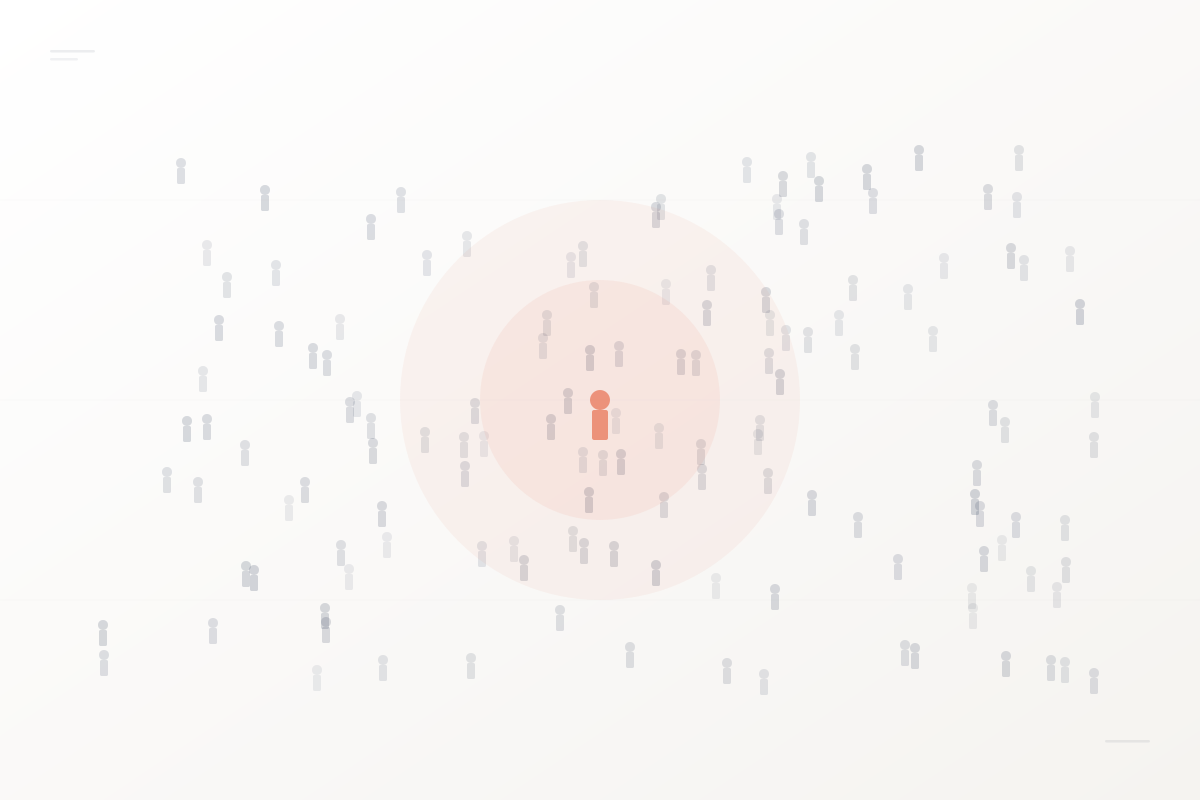
The average primary care physician in the United States manages a panel of approximately 2,500 patients. Some practices push that number higher. The math that follows from this number explains nearly everything about why your annual physical feels rushed, why abnormal results get a “let’s recheck in 6 months” instead of a plan, and why proactive health optimization doesn’t happen in standard primary care, not because doctors don’t want to do it, but because the system won’t let them.
The math of 2,500 patients
Start with the number: 2,500 active patients. Now calculate what a single physician can actually deliver.
A full-time physician typically sees patients 32-36 hours per week (the rest goes to documentation, calls, prior authorizations, and administrative work). Call it 34 hours of patient-facing time, about 2,040 minutes per week.
The standard primary care visit is scheduled for 15 minutes. After charting, documentation, prescription refills, and EHR navigation, the actual face-to-face time is typically 7-8 minutes, a figure that has been measured consistently across multiple published studies on primary care visit duration.
At 15-minute slots across an 8.5-hour clinic day, that’s roughly 28-34 patient encounters per day. Working about 48 weeks per year (accounting for vacation, CME, sick time), a physician can see roughly 6,100-6,900 patient visits annually.
If each of those 2,500 patients averages 2.5-3 visits per year, sick visits, follow-ups, annual physicals, that’s 6,250-7,500 visits needed.
The system barely fits, and only if nothing goes wrong. One complex patient who needs 30 minutes instead of 15 pushes two other patients into shorter slots. A flu season surge means routine follow-ups get delayed by weeks. A prior authorization for a single medication can consume 45 minutes of staff time.
The result: 7 minutes of face time per visit. Not because your doctor doesn’t care. Because 7 minutes is what the math allows.
What 7 minutes can and cannot do
Seven minutes is enough time to review recent labs and flag out-of-range values, refill medications, address one acute complaint, order a standard screening panel, make a referral.
Seven minutes cannot do this: explain why ApoB is a better cardiovascular marker than LDL-C, review fasting insulin trends and calculate HOMA-IR, interpret a DEXA scan and build a protein and resistance training plan, discuss what VO2 max means for mortality risk and how to improve it, deploy a CGM for a non-diabetic patient and review two weeks of glycemic data, or coordinate across a dietitian, health coach, and exercise physiologist.
The first set is reactive medicine, catch what’s broken, manage what’s chronic, refer what’s complicated. That’s what 7 minutes and 2,500 patients allow.
The second set is proactive assessment: measuring what predicts disease before it arrives, building plans to move specific numbers, coaching patients through behavior change. It requires more time than the structure provides.
Your doctor knows all of this exists. Many would prefer to practice that way. The economics of their practice don’t allow it.
Why the system works this way
Primary care in the United States runs on fee-for-service reimbursement. Physicians get paid per visit. Insurance reimbursement for a standard office visit ranges from roughly $75-$150, depending on complexity coding, payer, and geography.
At $100 per visit average and roughly 6,500 visits per year, a primary care practice generates around $650,000 in annual revenue per physician. After overhead, staff, rent, EHR systems, malpractice insurance, billing, the physician’s take-home is a fraction of that.
The only way to increase revenue in this model is to see more patients per day. More patients per day means shorter visits. Shorter visits mean less time for prevention, less time for explanation, less time for the kind of proactive care that keeps people healthy instead of waiting until they’re sick.
This is an economic structure that rewards volume over depth, not a failure of individual doctors. The physician who spends 45 minutes with one patient explaining their ApoB results and building a specific action plan earns the same, often less, as the physician who sees three patients in that time with standard visits.
The incentive structure selects against proactive care.
The concierge medicine response
Concierge medicine emerged as a direct response to this math. The premise: charge patients an annual fee, reduce the panel, give each person more time. A reasonable solution to a real problem.
MDVIP, the largest concierge network, typically reduces panels to 400-600 patients. Smaller boutique practices go lower. The annual fee, typically $1,800-$2,200 for MDVIP, subsidizes the revenue lost from seeing fewer patients.
What that buys you: longer appointments (typically 30 minutes instead of 15), same-day or next-day availability, direct physician access by phone or text, a doctor who actually knows your name and history.
What it usually doesn’t change: the underlying diagnostic model. Lab work still centers on LDL-C rather than ApoB. DEXA, VO2 max, and CGM aren’t standard. There’s no structured coaching or behavior change program. Follow-up still defaults to “see you in 6 months.”
Concierge medicine gives you 30 minutes instead of 7. That’s a genuine improvement. But 30 minutes of the same standard primary care framework is still standard primary care, delivered more comfortably.
Going from 2,500 patients to 400 changes the experience. It doesn’t necessarily change the medicine.
What happens in the 364 days between visits
Panel size alone can’t answer this question: what happens between appointments?
In a 2,500-patient practice, the answer is nothing, unless you initiate contact. Your annual labs sit in a portal. Your borderline results wait until next year’s recheck. The recommendation to “exercise more and eat better” lives in a chart note that no one follows up on.
In a 400-patient concierge practice, the answer is typically the same, just with a slightly lower barrier to reaching someone if you have a question. The physician is more available. But the structure between visits is usually no different, no coached follow-through, no retesting on a weeks-to-months cadence, no accountability for whether the recommendations were implemented.
Health optimization doesn’t happen during a visit. It happens in the weeks and months between visits, the meals, the training sessions, the sleep habits, the medication adherence, the small daily decisions that move biomarkers over time. Without a structure to support those weeks and months, even the best annual assessment is just a snapshot. It tells you where you are. It doesn’t help you get where you need to go.
If you’ve been told to “recheck in 6 months” after a borderline result, you’ve seen this gap firsthand. The recheck typically shows the same borderline number, because nothing happened between the two draws to move it.
50 Patients per physician: a different equation
Protocol operates at a ratio of 50 patients per physician. Not 500. Not 400. Fifty.
At that ratio, visits aren’t constrained by 15-minute scheduling blocks, they run as long as the clinical situation requires. Health coaches, registered dietitians, and nurse practitioners maintain contact between physician encounters. The 364 days between annual physicals aren’t empty.
What that time goes toward: ordering and interpreting ApoB, fasting insulin, HOMA-IR, Lp(a), hsCRP, the markers that your annual physical skips. DEXA scans and VO2 max testing with specific targets. CGM deployment and review for non-diabetic metabolic assessment. Module-based interventions with defined timelines and iterative retesting. Cross-domain coordination where your cardiovascular data informs your metabolic plan, your metabolic data informs your exercise prescription, and your sleep data informs everything.
Protocol’s 9 protocols, each built around a specific measurable headline metric, are only possible because the patient-to-physician ratio allows the depth required to measure, interpret, coach, retest, and adjust.
At 2,500 patients, you get disease management. At 400 patients, you get better disease management. At 50 patients, you get health optimization.
A systems problem, not a people problem
PCPs are, as a group, among the most overworked and undercompensated physicians in the specialty system. They chose a field built on relationships and got handed a system built on volume.
The physician who tells you “your labs look fine” at the end of a 7-minute visit isn’t being careless. They reviewed the markers they had time to order, interpreted them against the thresholds their system uses, and communicated the result in the minutes available. Within the constraints of a 2,500-patient panel, that’s competent care.
The problem is the constraints, not the clinician.
The more useful question isn’t “why didn’t my doctor catch this?”, it’s “am I in a system that’s designed to catch this?” In a 2,500-patient practice, the honest answer is no. The economics don’t leave room for early detection or proactive optimization. The system was built to manage established disease, and that’s mostly what it does.
If that’s what you want, you need a different system. Not a different doctor. A different structure.
What to do with this information
This isn’t an argument that everyone needs a 50-patient optimization model. If you’re managing a couple of chronic conditions and need someone reliable to refill prescriptions and order standard screenings, a 2,500-patient practice does that reasonably well. If you’re healthy, feel good, and have no specific risks to track, standard primary care may be all you need right now.
If you want better access and a longer relationship with one physician, concierge medicine closes that gap. More time per visit, same-day availability, a doctor who remembers your history. For many people, that’s the right call.
But if you want to know your actual numbers, ApoB instead of LDL-C, fasting insulin instead of just glucose, VO2 max instead of a stress test, DEXA instead of BMI, you need a provider with the panel size and the model to actually act on those markers. And if you want a plan to move them, with targets, timelines, and someone checking in between visits, you need a structure built around that from the start.
The 2,500-patient practice isn’t broken. It’s doing what it was built to do. The question is whether what it was built to do is what you actually need.
Ready to find out where you stand? Protocol’s Foundation Assessment measures what your annual physical misses, ApoB, HOMA-IR, DEXA body composition, VO2 max, and builds a specific action plan from the data.