

 ← Back to Blog
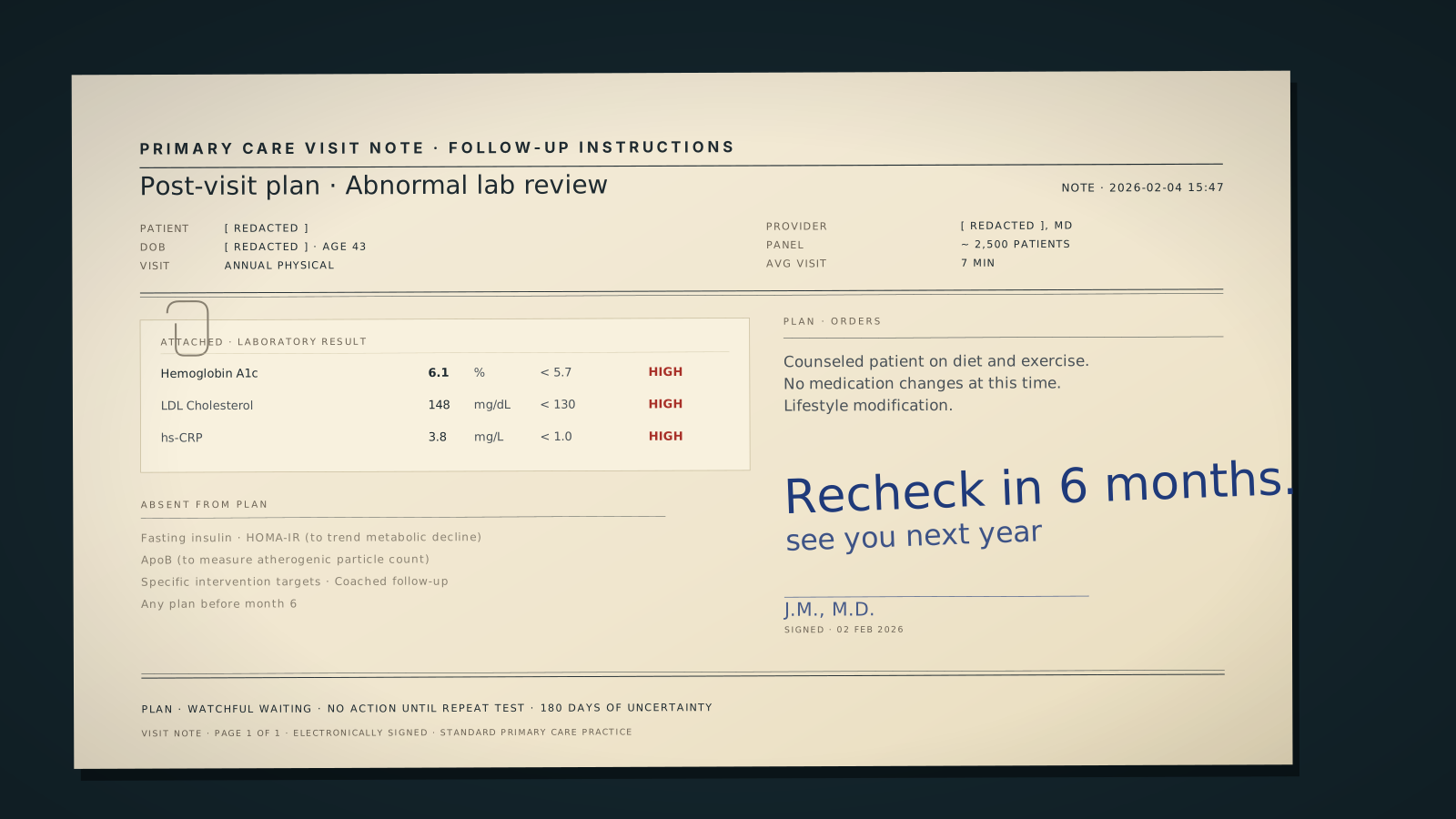
 I got a scary lab result and my doctor said 'recheck in 6 months'

I got a scary lab result and my doctor said “recheck in 6 months”
Your doctor said recheck in 6 months. You’re sitting in your car in the parking lot, staring at your phone, Googling what “borderline A1c” actually means. Or maybe it was your cholesterol, flagged high but not high enough for medication. Or an inflammatory marker you’d never heard of until today.
Your doctor didn’t seem alarmed. “Let’s keep an eye on it. Come back in six months and we’ll retest.”
Six months of not knowing whether something is actually wrong, whether it’s getting worse, whether you should be doing something different right now.
If this is you, take a breath. You’re not overreacting. And you’re not alone.
Why your doctor said to wait
Your primary care doctor is almost certainly a good clinician working inside a broken system.
The average PCP in the United States manages a panel of 2,500 patients. That works out to roughly 7 minutes per visit. In those 7 minutes, they need to address your chief complaint, review medications, handle any acute issues, and document everything for billing compliance.
Seven minutes. For everything.
When a lab result comes back “borderline,” the standard-of-care playbook says to repeat the test in 6 to 12 months. See if it trends. If it crosses the treatment threshold, then act.
This isn’t bad medicine. It’s triage. With 2,500 patients, your doctor has to allocate their limited time to the people who are clearly sick right now. Borderline results get queued.
The problem isn’t your doctor. The problem is that reactive medicine (the system your doctor practices inside) was designed to treat disease, not prevent it.
What “borderline” actually means
The part that should bother you: “borderline” doesn’t mean “fine.”
Borderline cholesterol. Most standard panels report total cholesterol and LDL-C (LDL cholesterol). LDL-C tells you how much cholesterol the LDL particles are carrying, but it doesn’t count the particles themselves. ApoB measures particle number directly, and in many people it predicts cardiovascular risk better than LDL-C alone. Cardiovascular risk is multifactorial, but LDL-C alone misses meaningful risk in a real subset of patients. ApoB is widely available as an add-on test at most labs, and it tells you something LDL-C can’t.
Borderline A1c. An A1c of 5.7% puts you in the “prediabetic” range. But A1c is a lagging indicator. It reflects your average blood sugar over 3 months, and by the time A1c moves, insulin resistance has typically been building for years. Fasting insulin and HOMA-IR catch the metabolic problem 5 to 10 years before A1c flags it. If your A1c is borderline, the real question is what your fasting insulin is doing.
Elevated inflammation. If your hsCRP (high-sensitivity C-reactive protein) came back elevated, the standard response is often “it could be anything.” That’s true. Infection, injury, stress, and autoimmune conditions all raise hsCRP. But persistent hsCRP elevation, in the context of metabolic and cardiovascular risk factors, is worth investigating now, not in 6 to 12 months.
In each case, “borderline” means you’re in a gray zone where standard care doesn’t have a clear action step, and where the gap between what gets tested and what’s actually happening is often largest.
Six months is not a neutral decision
Waiting 6 months feels like a cautious, responsible choice. It’s not. It’s an active decision with consequences.
If your borderline result reflects an actual trend (metabolic dysfunction, cardiovascular risk building, chronic inflammation), then 6 months is 6 months of continued exposure. Arterial plaque can accumulate. Insulin resistance can deepen. Inflammation does its slow, quiet damage.
This isn’t meant to scare you. But “watch and wait” carries a cost, and that cost is invisible because nothing dramatic happens during the waiting period. The damage is incremental. You don’t feel plaque forming. You don’t feel insulin resistance progressing. You feel fine right up until you don’t.
The alternative is to get the additional tests that clarify what “borderline” actually means for you, specific numbers, read in context, with a plan attached.
Don’t want to wait six months? Get the Foundation Assessment and replace the wait with a 2-week turnaround from testing to action plan.
What acting now looks like
Acting within weeks instead of months means getting the tests your standard panel didn’t include, understanding what they actually show, and building a plan with specific targets.
Here’s what that looks like for the three results that most often get flagged as “scary”:
If your cholesterol was flagged
Standard panels give you total cholesterol, LDL-C, HDL, and triglycerides. Those numbers don’t tell you the full story.
Two tests change the picture:
- ApoB is the most direct measure of cardiovascular risk. One number, and it tells you whether the LDL-C flag was real or noise.
- Lp(a) is a genetic cardiovascular risk factor that doesn’t respond to lifestyle changes. You only need to test it once, but you do need to test it, because if it’s elevated, it changes the whole management strategy.
Those two results, read together by a clinician who does this kind of work, turn a vague flag into a clear answer.
If your a1c was borderline
Standard care tests A1c and fasting glucose. Both are late-stage markers.
Two tests get there earlier:
- Fasting insulin catches hyperinsulinemia years before glucose starts moving. Most standard panels don’t include it.
- HOMA-IR combines fasting glucose and fasting insulin into a single insulin resistance index. Above 1.0 starts to tell a story. Above 2.0 is a clear signal.
At that stage, metabolic dysfunction is usually still reversible, through nutrition, exercise, or early pharmacological intervention, depending on where the numbers land.
If your inflammatory markers were elevated
Inflammation is nonspecific by nature. But in the right clinical context, it’s actionable.
Two things make an elevated hsCRP meaningful:
- A repeat reading 4 to 6 weeks later, in the absence of acute illness. One elevated value might be a passing infection. Two elevated values is a pattern.
- Metabolic context. Inflammation doesn’t exist in isolation, it runs alongside cardiovascular risk, insulin resistance, and body composition. An hsCRP reading without that context is like a single data point with no baseline.
The difference between data and a plan
Getting additional tests is step one. But data without interpretation is just more numbers to worry about.
What matters is what happens after testing. A target that means something, not “lower your cholesterol” but “get ApoB below 80 mg/dL within 12 weeks.” Interventions matched to your actual numbers. Follow-up in weeks. Someone who adjusts the plan when your numbers change, not in 6 months when the next appointment rolls around.
That’s the part most people never get.
What Protocol does differently
Most longevity medicine hands you a report and calls it done. Protocol doesn’t. Every member gets a specific plan with measurable targets and a clinical team that tracks it with them. The initial assessment matters, but it’s only the starting point.
Protocol’s Foundation Assessment is built for exactly this, when you have a result that concerns you and no clear path forward.
The Foundation Assessment includes:
- Labs your standard panel skipped: ApoB, Lp(a), HOMA-IR, fasting insulin, hsCRP, and a full metabolic panel.
- Body composition and fitness testing: DEXA for lean mass and visceral fat, VO2 max for cardiorespiratory fitness. Both are independent predictors of all-cause mortality.
- A clinical interpretation session, not a PDF of reference ranges, but a clinician walking through what your results actually mean.
- A specific action plan. If ApoB is elevated, you enter the cardiovascular risk protocol with a target and a timeline. If HOMA-IR is high, you enter the metabolic health protocol for reversing insulin resistance.
Testing to action plan in about two weeks. That’s the alternative to six months of not knowing.
Ready to act on your borderline result? Get the Foundation Assessment, the deeper labs, the clinical interpretation, and the action plan.
You don’t have to wait
That lab result in your patient portal might turn out to be nothing. Or it might be the earliest detectable sign of something that’s fully reversible right now and a lot harder to deal with in two years. You won’t know until you look.
Your doctor isn’t the problem. The system is. And you can get more information without abandoning your PCP, a Foundation Assessment is additional data and a proactive plan, not a replacement for your existing care.
The people who end up in the best shape at 60 are rarely the ones with the best starting genetics. More often they’re the ones who took an early signal seriously when it was still easy to act on.
Here’s your next step.
Ready to turn a scary result into a specific plan? Book a Discovery Call. We’ll walk through Protocol’s process for turning borderline biomarkers into optimal ones.
Related Content
Foundation Assessment→