

 ← Back to Blog
 Fountain life vs. Protocol: advanced screening vs. coached action
Fountain life vs. Protocol: advanced screening vs. coached action
If you’re comparing Fountain Life and Protocol, you’re already doing something most people never do: taking your long-term health seriously enough to spend real money on it. That’s worth acknowledging.
Both companies work in the space between “I feel fine” and “I have a diagnosis.” But they approach the problem differently. One bets that the right data will move you to act. The other builds the action into the program.
What fountain life offers
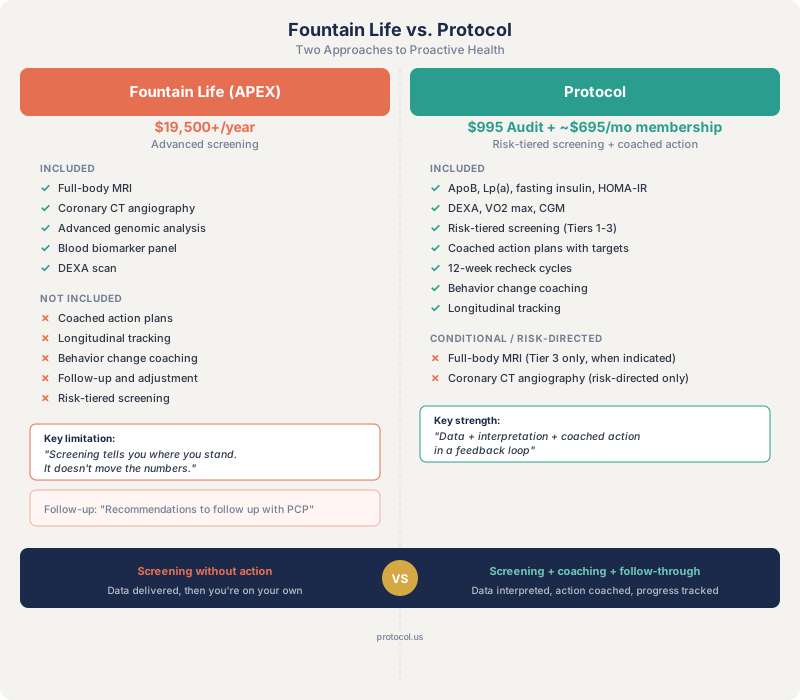
Fountain Life, co-founded by Peter Diamandis, positions itself as “the world’s most advanced longevity destination.” Its flagship APEX program typically costs $19,500 or more per year and centers on advanced diagnostics.
The screening stack is genuinely impressive. A typical APEX visit includes:
- Full-body MRI with AI-assisted analysis
- AI-guided coronary CT angiography (CCTA)
- Advanced genomic analysis
- Extensive blood biomarker panel
- DEXA body composition scan
- Continuous monitoring tools
These are real, clinically meaningful tests. Coronary CT angiography detects calcified and non-calcified arterial plaque before symptoms develop. Full-body MRI identifies structural abnormalities, aneurysms, tumors, organ pathology, that blood work can’t see.
For people with strong family histories of cancer or cardiovascular disease, advanced imaging catches things biomarkers miss. That’s not nothing.
Where it breaks down
The question isn’t whether Fountain Life’s diagnostics are good. They are. The question is whether advanced screening alone produces better health outcomes than screening matched to action.
The false positive problem
Whole-body MRI screening, when applied to asymptomatic populations, produces incidental findings in roughly 16% of cases, findings that trigger further workup but ultimately prove benign, based on systematic review data. Roughly 1 in 6 people who get a full-body MRI will have a finding that looks concerning but turns out to be nothing.
The American College of Radiology’s position: “no documented evidence that total body screening is cost-efficient or effective in prolonging life” in asymptomatic individuals, a stance it has maintained across multiple published statements.
That doesn’t mean full-body MRI is useless. It means the tool works best when directed by clinical context: family history, biomarker data, risk profile. Applied as a blanket screen, you get a lot of findings that don’t change anything, and a lot of anxious follow-up appointments.
The screening-to-action gap
After Fountain Life finds something (or finds nothing), what changes?
Advanced diagnostics produce data. Data is necessary. It isn’t sufficient. The distance between “you have early plaque” and “here’s the specific 12-week protocol to halt progression, with sessions, measurable targets, and escalation pathways” is large.
Screening tells you where you stand. It doesn’t move the numbers.
People who have gone through programs like Fountain Life routinely report getting their results with a single recommendation: follow up with your primary care doctor. Which lands you right back in the same system proactive medicine was supposed to bypass. The 7-minute visit. The 2,500-patient panel.
The price barrier
At $19,500 or more per year, Fountain Life’s APEX program reaches a narrow slice of the population. That’s not a knock on their business model, advanced imaging is genuinely expensive. But it raises a real question: if proactive health is only available to people who can spend $20K annually, how broad can its impact actually be?
The 45-year-old with a family history and a demanding job who’s been putting off their health, the person who would benefit most from early detection and intervention, often can’t justify a $19,500 annual commitment.
Protocol’s approach: risk-tiered screening plus coached action
Protocol’s argument is that the most valuable thing in longevity medicine isn’t the fanciest diagnostic. It’s what happens after: testing, interpretation, action, retest. The loop, not the scan.
Screening matched to your risk profile
Instead of applying the same imaging stack to everyone, Protocol uses a risk-tiered approach. Your initial biomarker data, family history, and health profile determine which screening modalities make clinical sense for you.
For cardiovascular risk: ApoB, Lp(a), and hsCRP provide the foundation. If those markers plus family history indicate elevated risk, targeted imaging (coronary calcium scoring, CCTA) is recommended, because now there’s a clinical reason to look, and the findings will directly change management.
For cancer risk: Protocol’s Cancer Prevention protocol uses evidence-based screening tiered to individual risk factors. If your family history, genetic markers, or biomarker profile warrant advanced imaging, you get it. If they don’t, you avoid the false positive cascade that comes with screening everyone identically.
The goal isn’t less screening. Smarter screening, directed where evidence supports it for your specific profile.
The part that changes outcomes
Protocol’s model is built around coached protocols that drive measurable change in specific biomarkers. This is where the two approaches split.
ApoB management example: In Protocol’s cardiovascular cohort, members entering with elevated ApoB move from 27% meeting optimal targets at intake to 69% at 6 months, through a combination of targeted intervention, clinician sessions, and iterative retesting. That’s not a screening result. That’s an outcome.
Each protocol includes:
- Specific targets. Not “improve your cholesterol” but “ApoB below 80 mg/dL”, a threshold consistent with cardiovascular risk reduction targets used in preventive cardiology.
- Sessions with a clinician who knows your data, tracks your progress, and adjusts the plan.
- Escalation pathways. If lifestyle intervention isn’t moving the numbers fast enough, there’s a clear decision tree for pharmacological options, discussed with evidence and without ideology.
- A retest cadence measured in weeks, not years. You see the numbers change (or not) and adjust accordingly.
Screening finds the problem. Protocols solve it.
Cost comparison
| Fountain Life APEX | Protocol | |
|---|---|---|
| Annual cost | Typically $19,500+ | $1,500 Foundation Assessment + $695/month membership |
| First-year total | $19,500+ | $9,840 (Assessment + 12 months) |
| What you get | Advanced imaging, genomics, biomarker panel, DEXA | Foundation labs (ApoB, Lp(a), HOMA-IR, hsCRP), DEXA, VO2 max, wearable data, coached protocols, iterative retesting |
| Ongoing action | Typically limited; follow-up with PCP recommended | Coached protocols with specific targets and timelines |
| Imaging | Full-body MRI, CCTA for everyone | Risk-tiered imaging directed by your biomarker and family history data |
Protocol’s first-year cost is roughly half of Fountain Life’s, and the ongoing membership ($695/month) includes the sessions and retesting that drive actual biomarker change.
If imaging is clinically indicated based on your risk profile, Protocol refers you to imaging partners. A coronary calcium score ($75-$200) or cardiac CT ($300-$800) is a fraction of a full APEX visit and is directed where evidence supports it.
Who should choose fountain life
Fountain Life makes sense for a specific kind of person. Strong family history of cancer with no identified genetic markers, full-body MRI can catch structural abnormalities that biomarker panels would miss. Someone for whom $19,500/year is not a meaningful financial decision and who wants the most extensive screening available. Or someone who has already done the work: ApoB at target, metabolic markers clean, fitness strong, and wants imaging as an additional layer rather than a starting point.
Those are real use cases.
Who should choose Protocol
Protocol is for people who have numbers they want to change, not just numbers they want to know.
If your A1c is 5.8, your ApoB is 110, your inflammation markers are creeping up, you don’t need another scan telling you that. You need a plan that moves those values, someone tracking your progress, and a system that adjusts when the first approach isn’t working.
The annual diagnostic event model works for people who are already optimized. Most people aren’t there yet. Protocol is built for the gap between “I got my results” and “I fixed the problem.”
And at $1,500 for the Foundation Assessment and $695/month for membership, it’s accessible to people who take their health seriously without a hedge fund budget.
The real question
Fountain Life wins the diagnostic firepower comparison. More imaging, more genomics, more tests.
The question worth asking is: which leads to measurable health improvement?
A full-body MRI that finds nothing doesn’t make you healthier. A full-body MRI that finds something and produces a “follow up with your doctor” recommendation doesn’t either.
Getting your ApoB from elevated to optimal, your HOMA-IR from insulin resistant to insulin sensitive, your VO2 max from the 30th percentile to the 60th, that’s the actual goal. And that requires coaching, specific protocols, and repeated measurement. Not just a scan.
Screening is the starting line, not the finish line.
Want to see what a coached approach looks like for your specific data? Book a Discovery Call, bring your existing labs (including Fountain Life results if you have them) and we’ll show you where the gaps are and what a specific action plan looks like.