

 ← Back to Blog
 Executive physical vs. foundation assessment: what $1,500 gets you that $5,000 doesn't

Executive physical vs. foundation assessment: what $1,500 gets you that $5,000 doesn’t
You’ve been thinking about an executive physical. Maybe your company offers one as a perk. Maybe you’ve been Googling “Mayo Clinic executive health program” or “Cleveland Clinic executive physical.” The pitch is appealing: a full day of testing at a world-class institution, thorough head-to-toe evaluation, results reviewed by top physicians.
Prices typically run $2,000 to $5,000 depending on the institution. Some go higher. It sounds like the kind of proactive health investment a serious person should make.
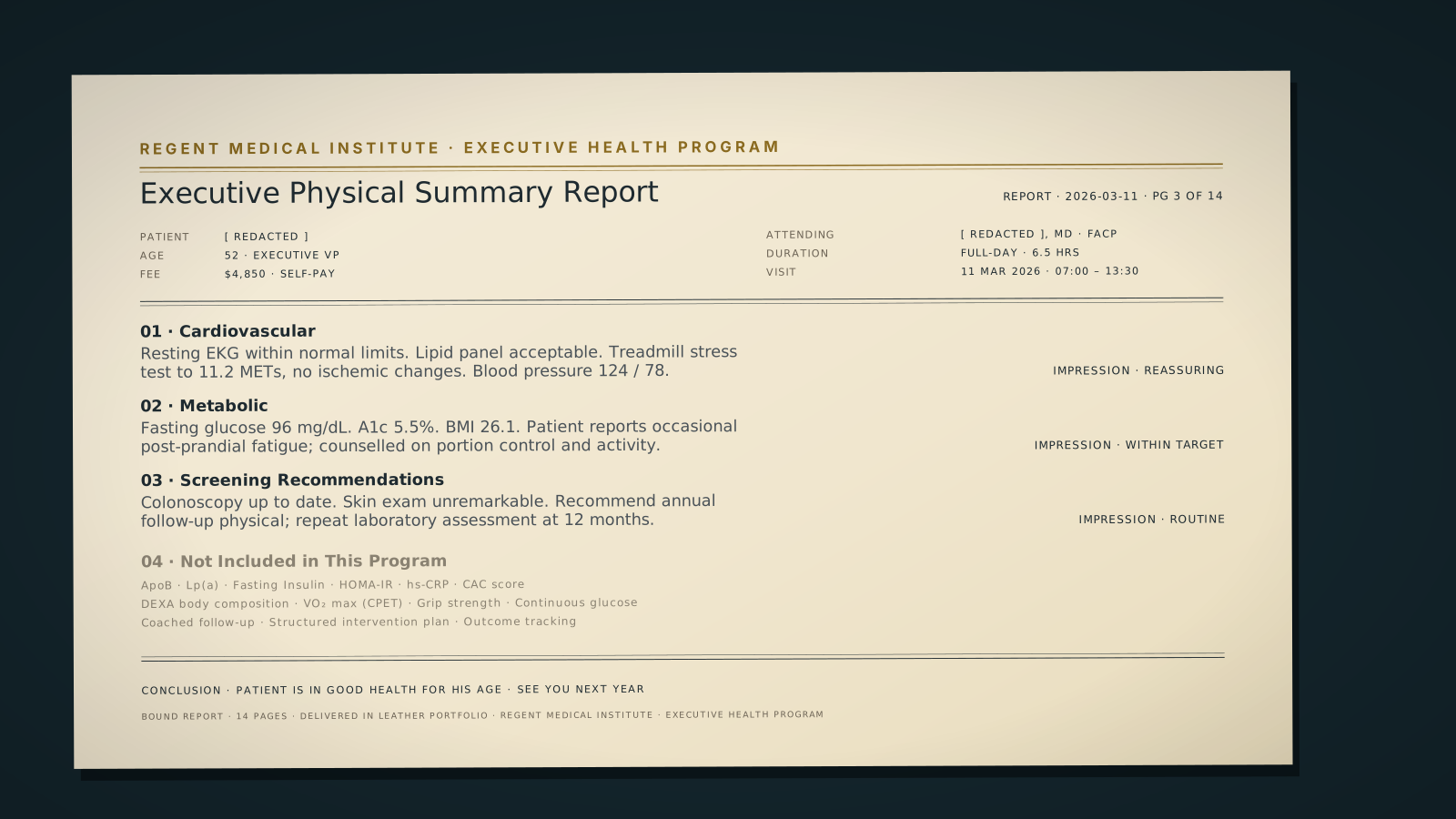
The problem: you’ll leave with a thick report, some generic recommendations, and a “see you next year.” And almost nothing will change.
What an executive physical typically includes
Credit where it’s due. Executive physicals at major academic medical centers are thorough on paper. A typical visit:
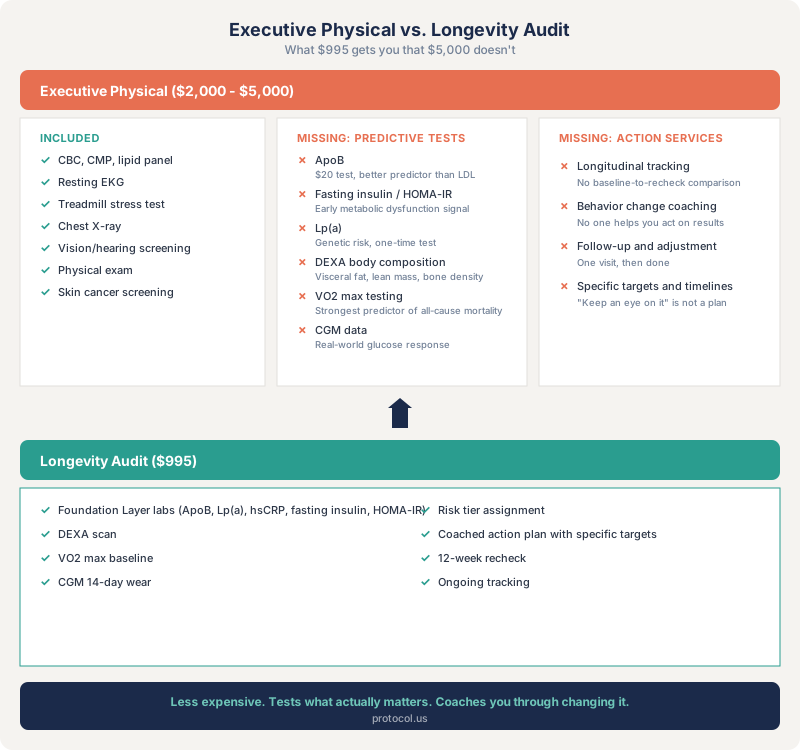
- Extensive blood panel (CBC, CMP, lipid panel, thyroid, liver, kidney function)
- Resting EKG
- Treadmill stress test
- Chest X-ray or low-dose CT (varies by program)
- Vision and hearing screening
- Physical exam with a physician
- Often: skin cancer screening, prostate exam (men), pelvic exam (women)
- Sometimes: carotid ultrasound, abdominal ultrasound, bone density scan
- End-of-day physician consultation reviewing all findings
It’s a lot of tests in a single day. The experience is polished, dedicated suites, minimal wait times, lunch provided. You feel taken care of.
What an executive physical typically doesn’t include
Here’s what’s usually missing from that $2,000 to $5,000 day. These are the tests and services that actually predict and prevent the diseases most likely to kill you.
Tests not typically included
ApoB. Most executive physicals report LDL-C (LDL cholesterol) as the primary cardiovascular lipid marker. LDL-C estimates cholesterol mass carried by LDL particles. ApoB directly counts the atherogenic particles, one ApoB molecule per particle, and is a better predictor of cardiovascular events. A substantial portion of cardiovascular events occur in people with “normal” LDL-C. ApoB catches risk that LDL-C misses. Cost to add: about $20.
Fasting insulin and HOMA-IR. Executive physicals test fasting glucose and sometimes A1c. Both are late-stage markers of metabolic dysfunction, they flag the problem after it’s been building for years. Fasting insulin and HOMA-IR (a calculated insulin resistance index) can detect the problem years earlier, while it’s still reversible through targeted intervention. Most executive physicals don’t order either one.
Lp(a). Lipoprotein(a) is a genetically determined cardiovascular risk factor present in roughly 20% of the population. It doesn’t respond to lifestyle changes, which is why you need to know about it early. It changes your entire risk management strategy. One-time test. Most executive physicals don’t include it.
DEXA body composition. Executive physicals measure your weight and calculate your BMI. BMI can’t distinguish between muscle and fat, can’t identify visceral fat distribution, and misclassifies a substantial percentage of the population. DEXA gives you lean mass, fat mass, visceral fat, and bone density, independent predictors of mortality that BMI obscures.
VO2 max testing. Cardiorespiratory fitness, measured by VO2 max, is one of the strongest predictors of all-cause mortality, stronger than smoking, diabetes, or hypertension in some analyses. A treadmill stress test tells you whether you have detectable cardiac ischemia under exertion. VO2 max tells you where you stand on the fitness curve that predicts how long you’ll live. Executive physicals include the stress test. Almost none include VO2 max.
Continuous glucose monitoring (CGM). A single fasting glucose reading is a snapshot from one morning. CGM data over 2 weeks shows how your body actually handles meals, sleep, stress, and exercise. It reveals glycemic variability that fasting numbers miss entirely.
Services not typically included
Longitudinal tracking. You get results in January. You come back in January next year. What happens in the 364 days between? Nobody tracks whether the recommendations were implemented, whether the numbers moved, whether the plan needs adjustment. The answer is usually: nothing happened.
Behavior change support. Executive physical reports end with lifestyle recommendations: lose weight, exercise more, eat better, manage stress. True and useless. Without specific targets, specific timelines, and accountability, generic recommendations change nothing. The research is consistent on this, information alone rarely changes behavior. Coaching does.
Follow-up on borderline results. If your executive physical identifies something worth watching, the typical recommendation is “follow up with your primary care doctor.” That routes you right back into the reactive system you were trying to get ahead of. The 7-minute visit. The 6-month recheck.
What the foundation assessment includes for $1,500
Protocol’s Foundation Assessment is an on-ramp, not a one-day event.
The lab panel covers the markers that actually matter: ApoB, Lp(a), hsCRP, fasting insulin, HOMA-IR, full metabolic panel, CBC, thyroid, vitamin D, ferritin, and additional markers based on age, sex, and risk factors. Then a DEXA scan for lean mass, fat mass, visceral fat, and bone density. VO2 max testing with percentile ranking. CGM for two weeks of real-world glycemic data. Activity and sleep tracking.
That’s the testing piece. The part that’s different from an executive physical is what happens next.
A clinician walks through every result, what matters, what’s noise, what to do about it. Not a PDF in your patient portal. An actual conversation. You leave with a specific action plan: module recommendations, measurable targets with timelines (e.g., “ApoB below 80 mg/dL by week 12”), and clear escalation pathways if the first interventions don’t move the numbers.
The real difference: what happens after testing
The executive physical model treats testing as the product. You pay for the day. The day is the deliverable. What happens afterward is up to you and your PCP.
The Foundation Assessment treats testing as the starting point. The product is the change that follows.
| Executive Physical | Foundation Assessment | |
|---|---|---|
| Cost | $2,000 - $5,000 | $1,500 |
| ApoB | Typically not included | Included |
| Fasting insulin / HOMA-IR | Typically not included | Included |
| Lp(a) | Typically not included | Included |
| DEXA body composition | Typically not included | Included |
| VO2 max | Typically not included | Included |
| CGM | Not included | Included |
| Follow-up plan | ”See your doctor” | Specific protocols with coached targets |
| Retest cadence | Annual | Weeks to months, based on intervention |
| Behavior coaching | Not included | Included in membership protocols |
The Foundation Assessment costs a fraction of what many executive physicals charge, includes the biomarkers that actually predict cardiovascular and metabolic risk, and comes with a plan rather than a pamphlet.
The snapshot problem
An executive physical is a snapshot. A very expensive, very thorough snapshot. But health is not a snapshot, it’s a trajectory.
Knowing your LDL-C was 142 on January 15th tells you very little if nobody checks whether it moved by March. Knowing your blood pressure was 128/82 during a stress test doesn’t matter if nobody follows up on what’s driving it.
The value of any health assessment is determined by what changes afterward. If the answer is “nothing changes until next year’s physical,” then the assessment, no matter how many tests it included, didn’t produce an outcome.
Protocol’s model runs on short feedback loops. Test. Interpret. Act. Retest. Adjust. That cycle, repeated over weeks and months, produces measurable biomarker change. The Foundation Assessment starts the cycle. Membership keeps it going.
Who should get an executive physical
There are cases where an executive physical makes sense. If your employer is paying, take it, free data is still data; just fill in the biomarkers it missed. If you have no existing health records and want a broad screen for anything obviously wrong, executive physicals are good at catching acute problems. And if the institutional credibility of Mayo or Cleveland Clinic matters to you and cost isn’t the issue, it’s a quality experience.
What executive physicals aren’t built for is optimization. They’re designed to find problems, not fix them. If you want to move specific numbers in specific directions over specific timelines, that’s a different kind of work.
Who should get a foundation assessment
The Foundation Assessment is built for people who want the assessment to be the start of something, not the end of it.
That means you want the biomarkers that actually predict cardiovascular and metabolic risk, ApoB, fasting insulin, HOMA-IR, Lp(a), hsCRP, not just the standard panel that hasn’t meaningfully changed since 1990. It means you want body composition and VO2 max data instead of a BMI calculation and a stress test result. And it means you want a specific plan with real targets, not a thick report full of advice you already knew.
The Foundation Assessment isn’t trying to be the most tests in one day. It’s trying to be the right tests, interpreted in context, with a clear path to action.
Testing is the easy part. Anyone with a credit card can get tested. The hard part, the part worth paying for, is knowing which tests matter, what the results mean for you, and what to do next.
That’s what $1,500 gets you that $5,000 doesn’t.
Ready to get the biomarkers that actually matter? Book a Discovery Call, we’ll tell you which of your existing results transfer and what the Foundation Assessment adds.
Related Content
Foundation Assessment→